Monday, 30 July 2012

Lammastide

Yesterday (29th July) Farm Crisis Network called for a day of prayer for our farmers. Thank you to Andy Rylands, our rural officer, who has sent this informative article which will help us to pray and think realistically for farmers at this busy time of year.

At Lammas tide, which on August 1st, it is traditional to take a loaf, made from the first grain of the harvest season, to be blessed in church and to ask for God’s blessing on the ensuing harvest. This loaf is then used to celebrate communion. Given the extremes of weather experienced in the Spring and early Summer this year, it is unlikely that many farmers will be in a position to harvest their crops by this date.

Early in the year while the talk was of drought conditions and hosepipe bans, many crops started to suffer from lack of moisture. Then we experienced unprecedented and near continuous rainfall for several months. Week after week we have heard of new records for high rainfall being established; for the majority of us this has simply been inconvenient while others have suffered dreadfully through repeated flooding. For our farmers, who toil all year long to provide us with the food we need, it can mean disaster.

Mild and wet conditions are ideal for the growth of fungi which attack crops and potentially devastate the yield. This leads to a difficult and potentially poor harvest with grain prices on the increase. Sadly good harvest weather is not in sight as yet, so this is of little comfort.

In the meantime, high grain prices are pushing up feed prices for livestock farmers, who are also suffering at the hands of the weather. Thousands of stock-farmers had to bring their animals back indoors to prevent them damaging valuable grazing land in the wet conditions. Because of this, many are obliged to feed their animals with costly winter forage or costly bought in feed – and with haymaking badly hampered until the weather improves, there is little prospect of being able to replenish those stocks before this coming winter. Without such reserves, many are very worried about the welfare of their animals in the cold months to come. 

On top of all this, we see dairy farmers, many of whom are already trying to cope with the devastation of bovine tuberculosis among their herds, having to contend with draconian price cuts for their milk, bringing them to a level, which for many is totally unsustainable. There is a very real likelihood of many dairy farmers simply going out of business.

Farming has always been a risky business and farmers are well used to managing those risks. This year, however, is proving to be quite exceptional, bringing with it concerns of a much greater magnitude than normal. When these worries are amplified by the isolation of rural living and the sense of neglect felt by many farmers, increasing pressures can prove too much, sometimes resulting in tragic and devastating consequences.  

So this Lammas tide, take a moment to consider the plight of our farmers and their families. They have the burden of  helping to feed the nation while managing and caring for our countryside in such difficult circumstances.

Farm Crisis Network is calling for a day of prayer on Sunday, 29th July for our farming community who everyday face the consequences of the uncertain weather and who often pay a much higher price than the consumers of their production.

The Right Reverend Donald Allister, Bishop of Peterborough, who is also an FCN Trustee, has composed the following prayer for use on Sunday:

Heavenly Father,

the earth is yours and the harvests are your bounty.

We pray for our arable farmers

in this year of extreme weather.

We pray for our dairy farmers

with supermarkets forcing the price of milk down

and with bovine TB in some parts of the country.

We ask your blessing on the harvest

and on all who work in farming.

We ask that farmers facing difficult times

may know your love

and our support.

Through Jesus Christ our Lord.
Amen

Oswald's Outlook on Askrigg Antics

For those interested in local Dales news, or anyone planning to holiday in Wensleydale, there is an excellent and informative little website called Oswald's Outlook


Very well worth a visit! And many thanks to Christine Hallas, church warden at Askrigg, for drawing my attention to it.

Table Talk from the Oswaldsoutlook website
I have to admit that I discovered this as a result of a visit to St Oswald's church Askrigg where I was down to preach on 'Good Shepherd' Sunday.  I was quaking in my boots at the thought of preaching to the good folk of Wensleydale about shepherds! What could I possibly tell them that they didn't already know? And would my 'facts' be found wanting? Well, I needn't have worried - I asked them to tell me what they knew about shepherds and we pieced together a picture of what Jesus meant when He called Himself the 'Good Shepherd'. I had no idea that real shepherds can be strict disciplinarians with their sheep, throwing stones to keep them from wandering off on the wrong path, for example. How much more fun and more memorable to preach the  sermon to each other. (And it looks as though the Jubilee celebrations were good fun in Askrigg, too!)

Drama at Kirkby Overblow


For those who follow the fortunes of Kirkby Overblow's Dramatic Society, you will be pleased (but perhaps not surprised) to hear that, at the recent Wharfedale Festival of Theatre Drama Awards Ceremony KODS once again came away with a small stash of awards.

Best Stage Presentation trophy - awarded to Bruce Noble for his fabulous set
Best Cameo performance - was jointly awarded to Lindsay McKenzie and Simon Hawkesworth
Best programme design - awarded to KODS
Telegraph & Argos Trophy - awarded to Adam Mckenzie for "his excellent standard of directing and playing in a leading role"

Well done to everyone involved!! We look forward to your autumn production.

Wednesday, 25 July 2012

Holy Land Pilgrimage


 Alison Askew and Michael Ganville-Smith are leading an 8 day pilgrimage to the Holy Land which promises to be the trip of a lifetime if you have never been, and a colourful opportunity to renew your acquaintance with this wonderful land if you have been before.

The pilgrimage will take in Jerusalem (including the Via Dolorosa), Bethlehem, Nazareth, Capernaum, Jericho and Caesarea.  You will sail on the Sea of Galilee, ascend the Mount of Temptation by cable car and visit the site thought to be the place to be of Jesus' baptism in the River Jordan. There will also be a chance to meet some of the local Christian community in Bethlehem.  The cost is around £1,455.

If you would interested in joining the group, and travelling in company with a group of Christians from North Yorkshire, please conact Alison or Michael.

alison.askew@btinternet.co
mglansmith@hotmail.com

Sunday, 22 July 2012

St Mary Mgdalen (Leper) Chapel, Ripon


An Address for the Patronal Festival Civic Service
with the Mayors of Ripon, Knaresborough, Pateley Bridge, Richmond
and representatives of North Yorkshire County Council and Ripon City Council

Luke 8.1-3


What a contrast between this peaceful, holy little chapel and our cathedral! Many of us are used to going to the cathedral for the big events - civic and military services, services which mark the great events of our life as a community and nation or the great feasts of the Christian calendar. It speaks to us of the majesty and authority of God. But this little chapel, founded almost 900 years ago by Archbishop Thurstan of York, speaks to us of God's love for the poor and the forgotten, for those on the margins of our society and for us when we are at those places of abandonment we all reach at some point in our lives.

Like this chapel, many parish churches have, somewhere near the altar, a peep hole. Through this, the priest could be observed at Mass by the many lepers who were, of course, banned from entering the churches for fear of their spreading infection. Even here, at this hospital, lepers could not be admitted to public worship in the chapel. They were absolute outcasts.

Victoria Hyslop wrote movingly about the pain of exclusion for those suffering from leprosy in twentieth century Greece in her novel, The Island. Once a person was known to be infected with leprosy, they were banished for life to Spina Longa, an island off the coast of Crete. Hyslop tells the story of the wife of the boatman who takes supplies to the island. This woman contacts leprosy herself. Knowing that she will be taken to Spina Longa and never allowed to return, she has to pack hastily. She can only take a very few belongings with her. She chooses to take her place setting from the family's dinner service. Though she will never share a meal with her family again, she hopes that, at meal times, they will in each other's thoughts.

Leprosy cruelly cut people off from their families and loved ones and made them outcasts, feared and shunned by everyone. In some societies, it still does so today. Imagine how much this little hospital must have meant to those lepers who came here on pilgrimage or who lived around the city's boundaries - a place of welcome and rest, of fellowship and hospitality in a very bleak world.

It's appropriate that St Mary Magdalen was chosen as patron saint for this place. St Luke tells us that Jesus healed Mary, casting out seven demons. With today's medical insight, we might say that she suffered from a severe mental illness. Even today, people with such illnesses speak of stigmatization and a sense that they are not accepted or understood. Mary would have known how the lepers who came to this place felt. She responded to Jesus' healing and love as many of the lepers coming to this place would have responded to the welcome they found here - this was a place where they could belong.

This little chapel, at the heart of a community of hospitality has spoken of the power of God's love for the outcast and forlorn for nearly 900 years. It has been a beacon of hospitality for people most of us forget or would like to forget as we go about our busy lives. At times, it has fallen into disrepair or disuse, even being used to house pigs at one point in its history, I believe. So it's very good to see that, today, there is again a committed, regular worshipping congregation and a strong group of Friends who are not only caring about the building, but developing it so that it can continue to be a place of hospitality as well as of worship and witness.

St Mary Magdalen's chapel reminds Ripon and the surrounding areas of the power of God's love for all people. Today, there are many people living in this area of Yorkshire who feel marginalized - not fully part of society's opportunities and successes. There are families and single people who are glad of foodbanks to put food on their tables; debt counselling projects that report that anxiety about debt and actual debilitating debt is a growing problem; older, housebound people who long for company and a chat and people caring for sick relatives who would love to get out and have a few hours recreation. There are families who struggle to allow their children the opportunities for education and travel that many enjoy. The organizations that support people with dementia and mental illness are becoming cinderella services with need outstripping provision.

Yes, today, there are some who feel and indeed are excluded from mainstream society. Jesus spent the lion's share of His time with people like this, people like Mary Magdalen and the lepers and blind Bartimaeus. He was to be found, with them, on the margins, in the forgotten places with the forgotten people, in the homes and streets where a little love, a little attention, a little practical help would go a long way.

This quiet, holy place is one we treasure, in Ripon. As we draw aside and enter its doors, we are reminded that God is a God who sees and knows and loves those who feel themselves abandoned and forgotten, who struggle each day for even their basic needs. Perhaps, this morning, we might like to dedicate ourselves afresh to Mary's way of responding to God's love. She was so grateful for what Jesus had done for her that she decided to get involved in His ministry herself. She and a small group of women travelled around with Jesus and His disciples 'providing for them out of their resources'. Perhaps some were wealthy and gave money, perhaps others were there to work and to supply the day to day needs of the whole group. Can you imagine how that felt for Mary? She whom everyone had feared and shunned was now at the centre of this little group. She had friends, she had people with whom to share and, more than that, she was using her resources to help other people to a better place. She was caught up in the healing ministry of Jesus.

However little, however much we have to offer God in response to His loving kindness to us, we too can be followers of Mary's example, disciples of Jesus, public servants whose way of living includes especially those who need just a little help or extra attention or love to live their lives more fully.

A prayer for all who come into this chapel:

Father, we pray Thee to fill this house with Thy Spirit. Here may the poor find succour and the friendless friendship. Here may the tempted find power, the sorrowing comfort and the bereaved the truth that death hath now dominion over their beloved. Here let the fearing find a new courage and the doubting have their faith and hope confirmed. Here may the careless be awakened and all that are oppressed be freed. Hither may many be drawn by Thy love and go hence, their doubts resolved and faith renewed, their sins forgiven and their hearts aflame with Thy love.

From the Chapel Porch, Pleshey Retreat Centre; Oxford Book of Prayer no.487 


For information about the Leprosy Mission go to

For details of the whole weekend's activities at St Mary Mag's go to

Greetings to the Revds John Langdon and Jackie Fox and to all the members of the congregation and the Friends of St Mary Magdalen, Ripon. Our prayers for your fellowship and work and also for the dedicated work of all who serve in local government in this region.


Abiding in Hope

I've noticed a lot of articles (blogs and media) lately suggesting that the church is dying. The authors of these pieces are hand-wringing over the fact that there aren't enough resources to keep things going, bemoaning the fact that churches are getting caught up into 'management-speak' and chastising these churches for losing sight of gospel values. Yet death is perhaps the least surprising concept to apply to the church which, in theological terms, is the body of Christ - Christ who died and who rose again. It's certainly true that churches (individual congregations and whole denominations) do struggle and wither and die out or, more prosaically, get to the point of closure. But it's also true that, while some get weaker and die, others blossom and flourish for a season. It is also true that where a church loses its vibrant, lively faith in the gospel, it is indeed as though the body is dying and being buried, but often, from that body, there comes a new shoot bearing fruit in the shape of individual Christians who have 'caught' the faith in that original fellowship and gone on to live it out in other Christian communities.

When I look around me at the churches of this area and indeed in the city where I used to minister, I see two things. I see the 'death' of shrinking numbers and wearied congregations but I also see the renewal of fresh lives changed by meeting Christ and tired lives brought to a place of re-invigorated engagement through exploring with new communities of faith and fresh opportunities for worship. Christian communities are being re-shaped and transformed at the present moment. In the West, they are much smaller than they were but they are also much more open to exploring what discipleship is. Church-going is no longer synonymous with practice of the faith - there are many unconventional, non-denominational and experimental groups outside or on the fringes of the old established denominations that are returning to the roots of the faith. They meet quietly or noisily in public places or each others' homes, members are often few in number and they break up again to reform in new groups to accommodate new members. They often have questions about leadership and the place of the sacraments. Remind you of anything? This shape of church is surely much more like the shape of the churches we meet in the New Testament and for the first three centuries in the history of Christianity.

I'm not sure that 'Christian' and 'large', or 'Christ-shaped' and 'powerfully influential'  are pairs of words that go together well. Resources have often been meagre - at the start of the church's history, at times of persecution and at times before major spiritual awakenings. Size and the sharing of clergy, money and buildings are very human preoccupations. We all worry about our responsibilities and none more so than an archdeacon, I suspect! A more theologically significant question to ask is 'where is
this apparent lack of resources pointing us?'  When churches struggle and need pruning and show signs of dying, there is always, in my experience, new growth in the off-ing. It might be in the very community where there is death - people of faith begin to emerge in other ways in the life of the community. Small groups of believers are suddenly released to focus on what is important and to re-invest their energy. Or it may be that, where whole areas or denominations begin to struggle, new life is found in radically different communities of faith. I do know that where churches are growing, it is almost always true that discipleship is taken very seriously; this happens in all sorts of different ways in different contexts, but attention to the disciplines of faith and, above all, devotion to the person of Christ are essential, whether this is expressed through worship and prayer, teaching, service, fellowship, generosity or usually a combination. 

So I don't share the despair of some. The Johannine sayings of Jesus about abiding in Him, Jesus' metaphors of pruning and the parables about death for the sake of new life give me hope that what we are seeing are the birth pangs (Romans 8) of a, yes maybe smaller, but more deeply rooted Christian community in Europe. Perhaps a more honest and humble community of faith full of people who are determined to worship and witness and serve without huge resources but in the power of God's Spirit. Scarey, yes, but certainly grounds for hope.                    

Saturday, 21 July 2012

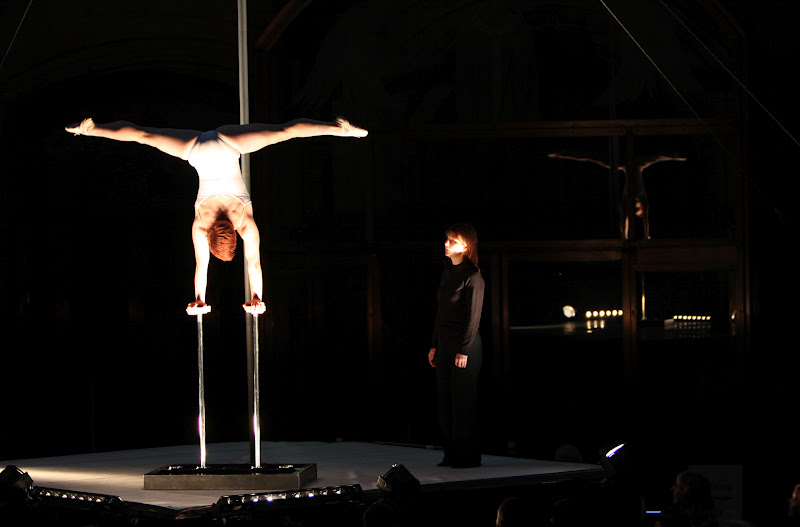
How Like An Angel at Ripon Cathedral

Bringing together Circa and I Fagiolini, two inspiring groups of artists in contemporary circus and vocal music. The third partner in the performance is the unique architecture and history of each cathedral where it is performed.

CIRCA originates in Brisbane, Australia, bringing us a daring new vision of circus, blending bodies, light, sound and artistry - this is the human body at its extremes of endurance, strength and versatility. 'Stunning., heart-stopping, unbearably beautiful.'

I FAGIOLINI is a group of vocal musicians rooted in the repertoire of the Renaissance and Baroque periods but also performing contemporary music. The sound moves around the building (as do the performers) and the quality of each individual voice and of the ensemble is arresting. Renaisssance polyphony at its stunning best in a building which lends itself to the form.
To hear a promotion for I Fagiolini's new show Tallis in Wonderland and to gain an insight into the aural quality of this performance go to

Circa Director Yaron Lifschitz
I Fagiolini Director Robert Hollingworth

Photos from Ripon Cathedral David M. Challoner


Tuesday, 17 July 2012

An Unusual Read

I've just been reading an unusual novel. Called A Perfectly Good Man, it's a new novel (published this year) by Patrick Gale and it tells the story of a parish priest in Cornwall. That was the reason I picked it off the bookshelf in Ripon's Little Bookshop. It appeared to be about rural parish life in a mining community which is gradually losing its mining industry.  In fact, it's about much more than that. The narrative is very ingenious, moving through time, but not always chronologically, telling the story from the perspective of different characters at different stages of their lives over a whole life span. As I read, I reflected that this is the way parish priests who stay awhile come to know their communities - they come to understand the different view point of each generation and also how things that have happened a long time in the past shape the future for good or ill and mean that certain relationships are bound to be special whilst others will always struggle to thrive.

The book is about the life and ministry of a very ordinary priest and his family. While revealing to us something of the inner joys and struggles of life in a clergy household, it also deals with the ways in which our birth families shape how we relate to spouses, children and those with whom our children make relationships. It shows what being a partly public figure throughout a lifetime does to family relationships for good and ill and it explores faithfulness, doubt, duty and that illusive sense of transcendence pervading the ordinary.

At one level this is a book about the faithful but unexciting life of a priest and yet it deals with themes which bring us to the edge of some of the greatest and deepest dramas of life and death. This is its brilliance - Gale somehow manages to show what difference a perfectly ordinary priest can make in the tangle of human life. Sometimes his actions make very little difference, occasionally his actions or his presence make a great deal of difference, sometimes the very little he does (maybe simply praying) make all the world of difference. Every priest will identify with this. And this unexceptional man encounters on his way still birth, adoption of a child from another culture, the suicide of a disabled person, illegitimacy, political action, drug abuse, disinheritance, retirement, bereavement, civil marriage, his own arrest, media pressure and issues to do with the way in which people with criminal records and inadequacies look to the local church for support and inclusion.

The delight of the book is that each character contributes to our understanding of the community and of the priest's ministry - it is not priest-centric. We also see how prayer and the intangible things that priests do are of value - a value that many will never appreciate but, nevertheless, at the heart of a life lived with and for God. We see how the sharing of brief moments of gentle or profound spiritual insight help to shape the lives of some of the people he encounters as well as his own life.

It is a book about a human father and son, their relationship, their deepening knowledge of one another and their suffering. It is a book about God and His relationship with all  human life, our deepening knowledge of God through the heights and depths of our existence and the way God both withdraws and meets us in our suffering. But you could just read it as simply a story about people finding their way towards truth and a priest who doesn't think he is achieving much. The book is, at the same time, both modest and profound.

A Perfectly Good Man Patrick Gale, Fourth Estate, Harper Collins 2012.

Monday, 9 July 2012

Florence Li Tim Oi


We have been focusing on women in the church here in England over the past 48 hours or so with debates about women bishops at the General Synod. I received a letter from Pam Wilding, the Chair of the Florence Li Tim Oi Foundation asking us to think about women in other parts of the world who do not have the chance of an education or any voice in the church or in their society. Many would love to be able to train as teachers, doctors, nurses, linguists, theologians, social workers. Many have political aspirations to reform their own churches and societies.  Li Tim Oi was the first ever woman priest in the Anglican Communion. I know that I would not have spent the last 25 years doing what I'm doing if it were not for her!  It may be that some churches or some individuals would like to act on what Pam suggests in her letter below - if you want to share in this with others, then do e mail me and I'll do my best to put you in touch. You can read the stories of some women who have benefitted from education arranged through the Li Tim Oi Foundation on http://www.ittakesonewoman.org/

The Revd Li Tim Oi
Pam writes

A year of celebration!

 This is an exciting year for England, with the London Olympics and the Queen’s Diamond Jubilee! 2012 also marks the 20th anniversary of the vote in General Synod to ordain women to the priesthood in the Church of England. Since that vote, over 5,000 women have been ordained as priests, with nearly 3,000 currently serving as licensed ministers. It is wonderful to realise that now a whole generation of children has grown up in our Church with women as clergy. Across the Anglican Communion there are many thousands more ordained women, with a growing number of the 38 Provinces opening their orders to women.

 A long and winding road

 Today we take this situation for granted, but women’s journey to ordination has been long and difficult. It is easy to forget the people who came before us and who took bold and courageous steps that helped to make all our ordinations, and the ordination of other Anglican women, possible. Most people do not know that the first Anglican woman to be ordained as a priest was a Chinese woman by the name of Florence Li Tim-Oi, who was ordained in 1944 in war-torn China by the Bishop of Hong Kong. Tim-Oi’s life reads like an adventure story, with much heartache, twists and turns, before her priestly ministry was finally accepted by the wider Church.

 The challenge goes on

 That was over 68 years ago, yet there are still places in the Anglican Church that do not ordain women, and also, in some of the provinces where women can be ordained, they do not have the resources. That’s why the Li Tim-Oi Foundation exists – to make it possible for women to train for ordained ministry, as well as for other Christian ministry. To date, the Foundation has enabled hundreds of women in the developing world to be trained for a wide variety of ministries, but there are so many more who long for the opportunity to be trained. We have seen what a tremendous difference just one educated Christian woman can make, and how she can become a catalyst for empowering others in her church and community, working to end prejudice and discrimination against women and harmful practices like female genital mutilations.

 The Revd Rose Mithamo from Kenya wrote to say, ‘I thank God for the way he has helped you to think about women, who are despised, less educated because of culture and who are seen as inferior and thus less fortunate in society. Through your help many women have been uplifted and trained, now having better chances of serving God in society.’

 Susan Ameso from Uganda, writes ‘Thank you for blessing me to bless others, for empowering me to empower others, and for giving me a sense of worthiness and respect as a woman.’

 It Takes One Woman

 We are asking you to remember Florence Li Tim-Oi and the many thousands of women who have showed such dedication, courage and faithfulness in the past, by holding a thanksgiving service or taking a special collection sometime this year. We owe so much to those who made it possible for us to be ordained. Will you do what you can to help? We are asking you to raise money and give what you can for those who are not able to test their calling. Even a small amount will go a long way to empower another woman’s life.

 It took one brave committed woman, Florence Li Tim-Oi, to say yes to being a pioneer in the Anglican Church. Thanks to her, you and I have been able to be ordained. Just think if we had been denied the opportunity or if we had not had the resources? The best way of showing our gratitude is to help transform the life of another woman. Please will you join me in helping to do that?

 If you would like materials for use in worship, booklets, publicity leaflets, GiftAid envelopes, bookmarks or other materials, please email mail to secretary@litim-oi.org

Share the Care

Imagine how you would cope if you were feeling generally very ill and tired and then you were told that the only way you could keep yourself alive was to have four hours of exhausting treatment two or three times a week in a hospital miles away from your home. This is the situation that faces people suffering from end stage renal failure (kidney disease). Haemodialysis, as it's called, is usually the only treatment available to people with severe Chronic Kidney Disease until such time as they can receive a transplant and as most of us know, the supply of translpant organs is not sufficient to meet the need, by a long way. Dialysis means that a person has to be connected up to a machine that takes the blood out of their system and pumps it through an artificial kidney which removes the toxins that are the product of every day living, and then returns it to them 'cleansed'. If the right equipment can be installed and if the person concerned has help and the confidence to undertake such a rigorous procedure each week, dialysis can be done at home. However, many people do not have the room to install the machines or they might not have a suitable water supply. Others simply can't manage the procedure themselves and may feel too ill to tackle it without on-hand medical supervision. This is where local hospital units that allow patients to come in and dialysis themselves with just a small amount of assistance are invaluable. If someone with kindey disease can travel a relatively short distance to a hospital with what's called a Shared Care Unit, they can be taught to manage their own dialysis fairly independently but  with on-call medical back-up if they need it. This means that fewer hours of medical practitioners' time are taken up than would be the case in a traditional dialysis unit and it also means that patients and their relatives can be supported and gain confidence in the procedures. They may then, at a later date be able to transfer to home dialysis.

At the moment people in our area generally have to travel to Darlinton, York or Leeds for dialysis. You can imagine that if you are also trying to hold down a job or look after children it can be extremely disruptive to have to travel so far. The York Teaching Hospital NHS Foundation Trust has launched a SHARE THE CARE appeal. They are aiming to raise £200,000 in order to provide a shared care dialysis unit at Harrogate Hospital.

There are around 23,000 people with Chronic Kidnet Disease in North Yorkshire.  For 175 with advanced disease, dialysis is a life line. You may well know someone who has the early stage of the disease. If you would be interested in learning more about this project or helping to fund raise,  visit www.york.nhs.uk/fundraising or e mail lucy.watson@york.nhs.uk

You can also make donations via www.justgiving.com/yorkteachinghospital

Smooth and efficient dialysis in a location near to home can transform the lives of  people who often feel fearful and very unwell, enabling them to live normal lives holding down a job, caring for their families and enjoying activities the rest of us take for granted.

Friday, 6 July 2012

The Price of a Pint

Yes, milk not beer!


Dairy farmers work some of the longest hours of anyone. Today, a month's rain has been forecast to fall over central England and Wales. And it's been churcking it down on and off for most of June. Just imagine having no choice but to go out and milk twice a day, seven days a week, in this! And then there's the six-feet-per-week dry stone walling one of my farmer friends tells me he has to do to keep his miles of walling in good shape. I recently met a farmer's wife who had broken her arm - no time off work for her, she simply had to adapt the way she milked and get it done. The price paid for milk by the large supermarkets simply does not cover the cost of production. And of course the biggest companies are able to influence the market heavily. Smaller farms (and some not so small) are going under week by week. The glorious variety of the British countryside, not to mention its stewardship, which most of us take very much for granted, depend on the survival and health of farms as solid businesses, large and small. If you would like to support your local dairy farmers, please take a moment to consider signing this petition

Dairy farmers must be paid more for their milk - e petition
http://epetitionsdirect.gov.uk/petition6424

For a discussion of the issues
http://fwi.co.uk/articles/06/07/2012/133803/Jim-Paice-on-milk-and-CAP-live-QampA-transcript.html