Showing posts with label Theology. Show all posts
Showing posts with label Theology. Show all posts
Friday, 28 September 2012
Miranda Threlfall-Holmes: The Essential History of Christianity: Christologi...
Miranda Threlfall-Holmes: The Essential History of Christianity: Christologi...: I've just received the first pre-publication copy of my new book, 'The Essential History of Christianity'. It summarises the key develo...


Saturday, 30 June 2012
Ministerial Training at Durham
Good news for theological education in the north! Durham University has been selected to become the Church of England's sole validation partner for training its ministers. While training institutions will be able to continue their relationships with other universities, the church will increasingly look to validate its own recognised courses through the one university. Currently the Church of England provides higher education for ordinands through validation links with 19 different universities. There has long been criticism that the plethora of different validating bodies for a relatively small number of students gives rise to confusion, complexity and extra costs. Certainly, when I worked in theological education, I can remeber crazy years when we were being inspected by two or more institutions who made conflicting recommendations. I sometimes spent more time preparing papers for the inspectors than preparing my teaching!
This move which has been set in motion by the Archbishops’ Council, will mean that Durham University will increasingly build relationships with the Church’s training institutes via its Department of Theology and Religion. This department is ranked as the top Department of Theology and Religion in the country with a great emphasis on internationally recognised research.
The new partnership will continue a tradition of ordination training at Durham that stretches back over 100 years. Durham is one of only a small number of universities, globally, where vocational training is offered at an internationally respected level in Theology and Ministry from Certificate to Doctoral level. The University has, for many years, validated courses within Cranmer Hall, the Wesley Study Centre for Methodist ministerial training, and, until very recently, Ushaw College, the Roman Catholic seminary. Professor Chris Higgins, the Vice-Chancellor of Durham University, said: “Durham is exceptionally well placed to work with the Church in this way because of our world position in theology and religion, and our considerable experience over 100 years of close partnership in ministerial training through St John’s College and indeed at an earlier stage, St Chad’s College. Our history, our current expertise and our long-term sustainability provides a fruitful soil to cultivate such a partnership.We look forward to working with the Church of England on this proposed partnership as we continue to develop the world-leading teaching, research and training available in theology and religion at Durham.”
During 2012, the University and representatives of the Church of England's Ministry Division will be working to develop a suite of common awards. New academic appointments will follow as a research centre for practical theology is set up and the first students will be admitted onto the new programmes in autumn 2014.
Congratulations to Durham University on this exciting new development! Read more at
Church of England announces new validation partnership | Christian News on Christian Today
This move which has been set in motion by the Archbishops’ Council, will mean that Durham University will increasingly build relationships with the Church’s training institutes via its Department of Theology and Religion. This department is ranked as the top Department of Theology and Religion in the country with a great emphasis on internationally recognised research.
 |
| Cranmer Hall, Anglican Theological College, Durham |
The new partnership will continue a tradition of ordination training at Durham that stretches back over 100 years. Durham is one of only a small number of universities, globally, where vocational training is offered at an internationally respected level in Theology and Ministry from Certificate to Doctoral level. The University has, for many years, validated courses within Cranmer Hall, the Wesley Study Centre for Methodist ministerial training, and, until very recently, Ushaw College, the Roman Catholic seminary. Professor Chris Higgins, the Vice-Chancellor of Durham University, said: “Durham is exceptionally well placed to work with the Church in this way because of our world position in theology and religion, and our considerable experience over 100 years of close partnership in ministerial training through St John’s College and indeed at an earlier stage, St Chad’s College. Our history, our current expertise and our long-term sustainability provides a fruitful soil to cultivate such a partnership.We look forward to working with the Church of England on this proposed partnership as we continue to develop the world-leading teaching, research and training available in theology and religion at Durham.”
During 2012, the University and representatives of the Church of England's Ministry Division will be working to develop a suite of common awards. New academic appointments will follow as a research centre for practical theology is set up and the first students will be admitted onto the new programmes in autumn 2014.
Congratulations to Durham University on this exciting new development! Read more at
Church of England announces new validation partnership | Christian News on Christian Today

Saturday, 7 January 2012
Life Sciences Teach Us About Growth
Some more good news! The Life Sciences industry (mainly focused on the creation and refinement of therpeutic drugs) is one area where Britain still makes a really major contribution to the world scene. We have four of the world's top 10 universities and there are welcome signs that the number of students studying physical chemistry is increasing. Indeed, it has been the International Year of Chemistry in 2011 and (unlike the Decade of Evangelism when church attendance actually fell!) there has been an increase in the number of students reading chemistry at university and there are plans to open two new chemistry departments at Lancaster and Kings, London. Since 2005, there has been a 25% increase in the number of students taking A level chemistry.
The science community must be pleased with the government's anouncement that there will be an extra £180m to fund processes which support getting the drugs from early stage development to clinical use (an area known by those in the profession, somewhat unfortunately, as the 'Valley of Death' because promising projects disappear into clincal trials never to see the light of day.) This is tied up with slightly more controversial plans to allow registered health care companies to access NHS patient records to support their research. The 4,000 UK life science companies who could benefit will be able to enhance their contribution both to new treatments for a number of diseases and to overall economic growth, so this seems like a win win package.
My husband's company releases employees to spend days teaching science in local schools and these days are always greeted with much enthusiasm by pupils and staff alike. They are also hugely enjoyed, it goes with out saying, by those released from workaday drudgery to be real 'mad scientists' under the attentive gaze of a class for the day! We need young people to study pure science subjects in order (among other things) to create the next generation of applied scientists.
It struck me that theologians ought to think along similar lines. Religious studies and
theology are valuable in so many ways apart from simply being of interest to those with a faith or the few intending to become ministers and priests. The study of theology opens a student up to history, philosophy, ethics, linguistics, sociology, psychology, art, music and textual criticism. One of my university colleagues once remarked that he was amazed that theologians seemed to have the capacity to be in dialogue with (and often teaching courses in partnership with) almost any other discipline in the university. The skills learned through studying for a theology degree can be used in so many ways.
Taking a leaf out of the scientists' approach to generating fresh interest in their subjects, we ought to be releasing our best theologians (and in this, I would include some clergy and readers) for days to help with the teaching of religious studies and other subjects in schools. In my last parish I used to help teach the A level philosophy modules in a local comprehensive; there were always a dozen or so students and I met some inspirational young people and learned a huge amount myself. Most importantly, I struck up some relationships that have lasted beyond the classroom as I've followed the students' progress into theology and philosophy courses and all sorts of related areas of study.
The science community must be pleased with the government's anouncement that there will be an extra £180m to fund processes which support getting the drugs from early stage development to clinical use (an area known by those in the profession, somewhat unfortunately, as the 'Valley of Death' because promising projects disappear into clincal trials never to see the light of day.) This is tied up with slightly more controversial plans to allow registered health care companies to access NHS patient records to support their research. The 4,000 UK life science companies who could benefit will be able to enhance their contribution both to new treatments for a number of diseases and to overall economic growth, so this seems like a win win package.
My husband's company releases employees to spend days teaching science in local schools and these days are always greeted with much enthusiasm by pupils and staff alike. They are also hugely enjoyed, it goes with out saying, by those released from workaday drudgery to be real 'mad scientists' under the attentive gaze of a class for the day! We need young people to study pure science subjects in order (among other things) to create the next generation of applied scientists.
It struck me that theologians ought to think along similar lines. Religious studies and
theology are valuable in so many ways apart from simply being of interest to those with a faith or the few intending to become ministers and priests. The study of theology opens a student up to history, philosophy, ethics, linguistics, sociology, psychology, art, music and textual criticism. One of my university colleagues once remarked that he was amazed that theologians seemed to have the capacity to be in dialogue with (and often teaching courses in partnership with) almost any other discipline in the university. The skills learned through studying for a theology degree can be used in so many ways.
Taking a leaf out of the scientists' approach to generating fresh interest in their subjects, we ought to be releasing our best theologians (and in this, I would include some clergy and readers) for days to help with the teaching of religious studies and other subjects in schools. In my last parish I used to help teach the A level philosophy modules in a local comprehensive; there were always a dozen or so students and I met some inspirational young people and learned a huge amount myself. Most importantly, I struck up some relationships that have lasted beyond the classroom as I've followed the students' progress into theology and philosophy courses and all sorts of related areas of study.
Friday, 1 July 2011
Radiance; a book review

Dan W. Hardy's last book (co-authored and published posthumously by his daughter, Deborah Hardy Ford, the Jewish philosopher, Peter Ochs and his son-in-law, the Regius professor of Divinity at Cambridge University, David Ford) is well worth consideration. Wording A Radiance; Parting Conversations on God and the Church, SCM Press 2010, is remarkable because it records the conversations of a dying theologian with a psychotherapist, a Jewish philosopher and a Christian theologian. The conversations grew out of a pilgrimage to the Holy Land and the book sets out some of Dan's last thoughts on God and on ecclesiology. It is not an easy read. As anyone who knew Dan will realise, he had a way of inventing new theological terms which he then explored from every possible angle and used to throw light on concepts which brought together theology with other disciplines.
In this book, he speaks a lot about 'abduction', a term he takes from his beloved Samuel Taylor Coleridge to refer to our capacity to be drawn by light and to see more than our perception without this light would allow. This process is associated by Coleridge, always, with God. It produces something akin to Hooker's 'divinely infused rationality' though Coleridge applies the term to moral, affective and somatic aspects of human life as well as to rational and cognitive ones.
Dan, in his pilgrimage to the Holy Land and in his mind (he had a brain tumour), is seeing light and seeing with eyes that lead him away from self engagement to attention to God and others. This leads him to reflect on both the church and the way in which society comes together. He talks about 'measurement' - a way of speaking about human attraction towards God (or lack of it), seeing Jesus' physical presence in Palestine, the scriptures and the eucharist as means of measuring the power of abduction in the world. This is heavy stuff, not easy to grasp per se, but additionally difficult because there is a real sense that Dan was running out of time to say all that he desired. The insights come thick and fast and are densely packed. The book (partly written by Dan and partly by his three co-authors) brings together personal narrative, a mature and distinct approach to theology and a mystical sense of the relationship between life and death, or at least of the sensibility of someone who is caught between the two.
 |
| Transcendence, Ripon Cathedral The Eucharist; a means of attraction Godwards |
To those of us who learned some of our systematic theology at Dan's lectures on ecclesiology, all this will come as no surprise. The book is very recognisably Dan at work, in full flow, asking, 'What is is that grows a good, whole human being and a good society?' and finding the answer in his own abuction Godwards.
Saturday, 28 May 2011
We Limit not the Truth of God
As the Scottish Church and the House of Bishops of the Church of England once again display the churches' preoccupation with and inability to solve issues around sexuality, I have been very struck by the hymn I re-discovered in my mother's old Congregational Praise as I was searching for appropriate hymns for her funeral service, this week. I remembered that she had said that she had always liked the sentiments expressed in this hymn. It seems to me to impart something of the openness to the future, inclusivity, and trust in the continued work of the Holy Spirit through human hearts and minds that I associate with the best of Congregationalism. It is based on the parting words of Pastor John Robinson to the Pilgrim Fathers in 1602 and was written by George Rawson (1807-1889).
We limit not the truth of God
To our poor reach of mind,
By notions of our day and sect,
Crude, partial and confined:
No, let a new and better hope
Within our hearts be stirred:
The Lord hath yet more light and truth
To break forth from His word.
O Father, Son and Spirit, send
Us increase from above;
Enlarge, expand all Christian souls
To comprehend Thy love;
And make us all go on to know,
With nobler powers conferred,
The Lord hath yet more light and truth
To break forth from His word.
I resonate with the notion of truth breaking forth from God's Word - not simply emerging or shining, but struggling to get out. Scripture has been interpreted in ways that have done untold damage to people and to the earth, as well as in ways that have brought life and hope and insight and education. Christians have so often been, and so often are, wrong or limited by preoccupations with our own very insular understanding of culture and how God speaks through it. Things that have seemed immutable laws in the past come to be seen in a new light as our understanding and knowledge develop; scripture requires constant interpretation in the light of what the Spirit is telling the churches. A change in understanding does not necessarily imply inconsitency in scripture or God's wisdom, but rather in the human capacity for understanding and wisdom. I am grateful to God and to my mother for the insights of her cherished theological tradition and a life which included service in WRNS during the second world war and in Ghana.
We limit not the truth of God
To our poor reach of mind,
By notions of our day and sect,
Crude, partial and confined:
No, let a new and better hope
Within our hearts be stirred:
The Lord hath yet more light and truth
To break forth from His word.
O Father, Son and Spirit, send
Us increase from above;
Enlarge, expand all Christian souls
To comprehend Thy love;
And make us all go on to know,
With nobler powers conferred,
The Lord hath yet more light and truth
To break forth from His word.
I resonate with the notion of truth breaking forth from God's Word - not simply emerging or shining, but struggling to get out. Scripture has been interpreted in ways that have done untold damage to people and to the earth, as well as in ways that have brought life and hope and insight and education. Christians have so often been, and so often are, wrong or limited by preoccupations with our own very insular understanding of culture and how God speaks through it. Things that have seemed immutable laws in the past come to be seen in a new light as our understanding and knowledge develop; scripture requires constant interpretation in the light of what the Spirit is telling the churches. A change in understanding does not necessarily imply inconsitency in scripture or God's wisdom, but rather in the human capacity for understanding and wisdom. I am grateful to God and to my mother for the insights of her cherished theological tradition and a life which included service in WRNS during the second world war and in Ghana.
Thursday, 7 April 2011
The Anglican Covenant
I guess Church of England readers of this blog will have, at some level, taken on board the discussions which are around about the adoption of a Covenant (not to be confused with the Anglican/Methodist Covenant) which is intended to keep the Anglican Communion together (ie. keep all the different provinces within the Anglican Church talking to each other.) Sounds a good idea? Well yes, but Anglicans have never had formal structures of this kind to keep the church together and the worry is that once we start defining who is 'in' and who is 'out' by signing up to fixed statements, there will inevitably arise the frought question of who is 'out' and why and by what means they are kept 'out'. There is also the danger that, despite all the very laudable things the Covenant says about listening, the Communion will then spend more time than it already does arguing about divisions instead of the constituent churches talking to each other and learning from one another. Of course, some existing members of the Communion will undoubtedly refuse to accept the Covenant and so the Covenant will then, in effect, strengthen the barrier between the provinces who do accept it and those who don't. Some people simply think that this way of being church is un-Anglican, while others see it as the only way to save as much of the present Communion as possible and to ensure the continued existence of world wide Anglicanism.
If, like me, you are wondering how to make sense of it all, you might be grateful to know that the Church in Wales has produced a very helpful and mercifully shortish(12 pages!) commentary on the proposed Covenant and its significance. The Governing Body of the Church in Wales has a very good record of dispassionate, courteous and intelligent debate around difficult issues. The Secretary of the group that produced the proposed Covenant is the current Bishop of St Asaph, so that might also explain their clear approach to the subject. Below are the sites where you can find (first) the proposed Anglican Covenant itself and (second) the Church in Wales' commentary on it.
http://www.anglicancommunion.org/commission/covenant/docs/The_Anglican_Covenant.pdf
http://www.churchinwales.org.uk/resources/acc/docs/gb_paper.pdf
Do make your views known to your elected members of the General Synod of the Church of England as they, too, will be voting on whether the C of E should sign up to it. This is an important issue and, though complex, it is worth thinking about because the decisions which provinces make will radically affect the shape of worldwide Anglicanism in the future. I have always been very glad to belong to a church which has deep, shared roots with churches in provinces across the world but which allows each province to bring to the table its own unique insight about what it means to be an Anglican Christian in a particular context. I have learned so much from the provinces with whom the dioceses where I have served have had links (Natal, Malawi and Sri Lanka.) And I have also derived a great deal of inspiration from the Episcopal Church in the USA which, itself, has dioceses on several continents.
If, like me, you are wondering how to make sense of it all, you might be grateful to know that the Church in Wales has produced a very helpful and mercifully shortish(12 pages!) commentary on the proposed Covenant and its significance. The Governing Body of the Church in Wales has a very good record of dispassionate, courteous and intelligent debate around difficult issues. The Secretary of the group that produced the proposed Covenant is the current Bishop of St Asaph, so that might also explain their clear approach to the subject. Below are the sites where you can find (first) the proposed Anglican Covenant itself and (second) the Church in Wales' commentary on it.
http://www.anglicancommunion.org/commission/covenant/docs/The_Anglican_Covenant.pdf
http://www.churchinwales.org.uk/resources/acc/docs/gb_paper.pdf
Do make your views known to your elected members of the General Synod of the Church of England as they, too, will be voting on whether the C of E should sign up to it. This is an important issue and, though complex, it is worth thinking about because the decisions which provinces make will radically affect the shape of worldwide Anglicanism in the future. I have always been very glad to belong to a church which has deep, shared roots with churches in provinces across the world but which allows each province to bring to the table its own unique insight about what it means to be an Anglican Christian in a particular context. I have learned so much from the provinces with whom the dioceses where I have served have had links (Natal, Malawi and Sri Lanka.) And I have also derived a great deal of inspiration from the Episcopal Church in the USA which, itself, has dioceses on several continents.
Thursday, 24 March 2011
A. S. Byatt
I was fascinated by novelist A.S.Byatt's recent observation that digital communication may sound the death knell of religion. I heard her saying that phenomena like facebook seem to be creating a world in which people try to form their identity through the responses they receive on interactive media such as facebook. You don't really feel good unless someone is sending you a message or tweeting or letting you know they like your latest post or image. The more people look at your profile, the more your sense of personal identity is strengthened and the more you grow in confidence. Self-worth means having friends who respond to your messages daily or tweet several times a day. The more responses you get, the greater your sense of your own value. If everyone appears to be ignoring you, what are you worth? Who are you?
How does this relate to religion? Well, Byatt argues, people have tended in the past to look to religion as a key source of their sense of value. They have sought meaning in religion personally. Think of the words of God at Jesus' baptism, 'This is my Son in whom I am well pleased' - this is also the the message of acceptance given to every child or individual at their baptism. And then people have sought corporate meaning in religion. They have looked to the world faiths to give a sense of pattern and overall coherence to existence, a map which helps them find their place amid complexity and shifting sands, 'What are human beings that you are mindful of them and mortals that you care for them? Yet you have made them a little lower than God and crowned them with honour.' (Psalm 8.3-5)
So, is the value that is imparted to a person through the digital world gradually beginning to usurp the place of other sytems of value, including religion? My first reaction to this was to think that to find a reflection of who you are and to seek a feeling of self worth through internet relationships is no different from worshipping at the shrine of other false gods. Haven't we comfort-shopped and comfort-eaten and over-consumed and complained if we can't exercise endless choice in order to feel good about ourselves? How is allowing the internet to stoke up our sense of self-worth any different? All these things, including the internet, are but idols when used in ways that set them up as answers to our frail sense of who we are. But then I began to think that Byatt is on to something more profound, here. The artefacts of consumerism and choice are not interactive in quite the same way as digital media and...here I begin to flounder....what is possible with digital technology is changing so fast that it does begin to seem that the boundaries of the real and the illusory, of the actual and the virtual, of the memory of what happened and memory of what didn't really happen are getting blurred in previously unimaginable ways. Will an increasingly digitally manipulated world lead us so far into the virtual and the illusory that we will lose touch with our own power to apprehend what is in fact influencing us? I want to argue that digital media do not necessarily lead away from God and that the presence of God may be deeply apparent in this brave new world (and also God's absence.) However, as the forms through which we communicate radically change, religion - the systems by which we apprehend and understand God - is going to start to look and sound different. Religion has always adapted and been adapted; it has struggled with questions about what is real and what is illusory but it needs (and especially so for the Christian faith with the doctrine of incarnation at its heart) people to be encountering the life of God through the manifestations of new media and not holding back. To hold back and exercise caution is one thing as change takes place over centuries (as with the dawn of printing) but it is quite another when the change is taking place so quickly that there is little time for reflection and adaption. So I think Byatt is perhaps correct to see in the ways people are beginning to communicate something that will increasingly pull us away from religious expression. I suppose, however, that a theologian may have less cause to be pessimistic about this than a novelist whose great challenge is to portray human nature. The story of God's nature, at least in the Judeao Christian tradition, has always been the story of how creation has pulled away from the creator and I would see the digital age as the next episode in this narrative rather than the end of religious narrative. But it does all look very challenging or, at least, unimaginably different!
How does this relate to religion? Well, Byatt argues, people have tended in the past to look to religion as a key source of their sense of value. They have sought meaning in religion personally. Think of the words of God at Jesus' baptism, 'This is my Son in whom I am well pleased' - this is also the the message of acceptance given to every child or individual at their baptism. And then people have sought corporate meaning in religion. They have looked to the world faiths to give a sense of pattern and overall coherence to existence, a map which helps them find their place amid complexity and shifting sands, 'What are human beings that you are mindful of them and mortals that you care for them? Yet you have made them a little lower than God and crowned them with honour.' (Psalm 8.3-5)
So, is the value that is imparted to a person through the digital world gradually beginning to usurp the place of other sytems of value, including religion? My first reaction to this was to think that to find a reflection of who you are and to seek a feeling of self worth through internet relationships is no different from worshipping at the shrine of other false gods. Haven't we comfort-shopped and comfort-eaten and over-consumed and complained if we can't exercise endless choice in order to feel good about ourselves? How is allowing the internet to stoke up our sense of self-worth any different? All these things, including the internet, are but idols when used in ways that set them up as answers to our frail sense of who we are. But then I began to think that Byatt is on to something more profound, here. The artefacts of consumerism and choice are not interactive in quite the same way as digital media and...here I begin to flounder....what is possible with digital technology is changing so fast that it does begin to seem that the boundaries of the real and the illusory, of the actual and the virtual, of the memory of what happened and memory of what didn't really happen are getting blurred in previously unimaginable ways. Will an increasingly digitally manipulated world lead us so far into the virtual and the illusory that we will lose touch with our own power to apprehend what is in fact influencing us? I want to argue that digital media do not necessarily lead away from God and that the presence of God may be deeply apparent in this brave new world (and also God's absence.) However, as the forms through which we communicate radically change, religion - the systems by which we apprehend and understand God - is going to start to look and sound different. Religion has always adapted and been adapted; it has struggled with questions about what is real and what is illusory but it needs (and especially so for the Christian faith with the doctrine of incarnation at its heart) people to be encountering the life of God through the manifestations of new media and not holding back. To hold back and exercise caution is one thing as change takes place over centuries (as with the dawn of printing) but it is quite another when the change is taking place so quickly that there is little time for reflection and adaption. So I think Byatt is perhaps correct to see in the ways people are beginning to communicate something that will increasingly pull us away from religious expression. I suppose, however, that a theologian may have less cause to be pessimistic about this than a novelist whose great challenge is to portray human nature. The story of God's nature, at least in the Judeao Christian tradition, has always been the story of how creation has pulled away from the creator and I would see the digital age as the next episode in this narrative rather than the end of religious narrative. But it does all look very challenging or, at least, unimaginably different!
Great is the Mystery of Faith
How many times have you heard the priest say those words, inviting the congregation to respond 'Christ has died, Christ is risen, Christ will come again!' Where do they come from? Why have they found a home at the heart of the new Eucharistic prayers and why didn't Cranmer know about them - or did he? If you don't know the answers to those questions, you need to buy Paul Ferguson's new book! Paul is Archdeacon of Cleveland in North Yorkshire and a former Precentor of York Minster. One of the few people I have met who can rise from the dinner table to illustrate an obscure piece of Gerald Finsey (a Harrogate born-composer), by ear, at the piano! And also one of the few archdeacons I know who can make even a lecture on Common Tenure sound interesting. So get him on the topic of worship and how our worship helps us in our growth as Christian disciples and you have something worth reading!
His new book is a great resource for those who lead or participate in worship Sunday by Sunday (or day by day) and who would like to understand a bit more about the root of some of the texts we take for granted, texts which, one might argue, will shape the English of the future perhaps not quite as extensively as the King James Bible but, undoubtedly, to a degree. The book also explores the theological and liturgical significance of many of the things we say in worship and would be a good basis for a short course of study or a Lent group. Reading it will help to deepen our relationship with the worship moulds us.
Great is the Mystery of Faith; Exploring Faith Through the Words of Worship Paul Ferguson, Canterbury Press, Norwich, 2011 ISBN 978 1 84825 055 0
 |
| The Ven. Paul Ferguson, Archdeacon of Cleveland |
His new book is a great resource for those who lead or participate in worship Sunday by Sunday (or day by day) and who would like to understand a bit more about the root of some of the texts we take for granted, texts which, one might argue, will shape the English of the future perhaps not quite as extensively as the King James Bible but, undoubtedly, to a degree. The book also explores the theological and liturgical significance of many of the things we say in worship and would be a good basis for a short course of study or a Lent group. Reading it will help to deepen our relationship with the worship moulds us.
Great is the Mystery of Faith; Exploring Faith Through the Words of Worship Paul Ferguson, Canterbury Press, Norwich, 2011 ISBN 978 1 84825 055 0
Sunday, 20 February 2011
The English Parish Church
I thoroughly enjoyed Richard Taylor's insights into the significance of the English parish church (BBC2 Friday evening Churches, How to Read Them.) Searching behind our Victorian and post Reformation history, we find inspiration for returning parish churches to the centres of life that they once were, embracing every aspect of daily life and offering protection and assistance from the cradle to the grave.
How does this sound - games, children playing and drama in church, sports and fayres in the churchyard, business transacted and courts held in the porch, cartoons (in their time) of bible stories and theological truths in the frescos on the walls, and areas of the church given over to special uses - for children, for baptisms, for churchings (women giving thanks after childbirth) and for trading and holding meetings. In particular, Taylor showed us a marvellous font in a Herefordshire church which depicted the whole story and theology of Jesus' baptism. He also showed us an area of a church with beautiful images of mothers and of St Margaret, the patron saint of chidbirth, where women had come to pray for strength and safe delivery before giving birth. Apparently, unidentified corpses were laid out in some church porches so that families could claim their mssing dead. The church was the place people naturally came for help, advice, support and in times of personal difficulty.
Some parishes are beginning to return their churches to the community in exciting new ways and to welcome a rich diversity of events to take place there. A few have never stopped being places of gathering for the whole community. Others are more cautious and the fragrace of 'reverence' and severity pervades at all times - there is not a square inch without a pew in which to do anything! In the last parish where I worked as a parish priest, we used to hold our annual church festival in the churchyard in and among the graves. One or two people commented that it seemed a bit irreverant but most people welcomed the convivial atmosphere and thought that it was good to mix life with a remembrance of those who had once lived and enjoyed such events in their village. We also had games sessions for toddlers in church, often pausing to marvel, through a three year's eyes, at some of the artefacts in the church. Again, not everyone approved but the number of young families attending church improved dramatically! Many of the churches I visit now have special places set aside for prayer with candles, prayer trees and other prayer aids. Spaces for young children (some more convivial than others) are quite common, as are areas for exhibitions, infomation, art work and local photography. One or two churches even have places where visitors can make themselves a cup of tea. And I'm glad to say that a very large number of our country parish churches are open in the daytime.
In our generation, we tend to be rather shy of using churches for business (unless they are redundant and have been turned into carpet warehouses or pottery shops!) But medieval churches were places where a lot of business was carried out and where people came for justice and for education and information. People also caught up on gossip and ate in the nave. If you walked to a morning service and stayed for the evening service, you needed somewhere to shelter and eat in between. Personally, it always gladdens my heart when I discover churches that offer services the community needs, values and enjoys, even where this leads to money changing hands and crumbs in the transepts! It is also great to see churches used for lectures and meetings and these do not always need to be religious ones! It is all about balance and the PCC retaining proper control of the building so that at times when the building needs to provide a quiet, dignified and reverential atmosphere, this can be achieved.
A few months ago, I took services at Downholme and Marske and I was moved by a deep sense, in both churches, that here were about 16 or 20 of us worshipping very much in the way that people had worshipped at the Reformation and even before it. Yes, some of the words had changed and, yes, the music had changed but, essentially, there had probably been a couple of dozen people from these villages saying their prayers together, celebrating Holy Communion and marking the joys and sorrows of people's lives in these sacred spaces for the past several hundred years. Box pews, pulpits and sanctuary spaces had changed, but the sense of the life of the community flowing through the church had not changed and nor had the expectation of meeting with God here. Nor, I suspect, had the fact that most of the village were not in fact present!
Let's find every way we can to open our churches up to people, to make them welcoming, interesting, enjoyable places to be!
You can view Richard Taylor's program on
http://www.bbc.co.uk/iplayer/episode/b00tp1cs/churches_how_to_read_them_medieval_life
 |
| St Michael's Downholme |
Some parishes are beginning to return their churches to the community in exciting new ways and to welcome a rich diversity of events to take place there. A few have never stopped being places of gathering for the whole community. Others are more cautious and the fragrace of 'reverence' and severity pervades at all times - there is not a square inch without a pew in which to do anything! In the last parish where I worked as a parish priest, we used to hold our annual church festival in the churchyard in and among the graves. One or two people commented that it seemed a bit irreverant but most people welcomed the convivial atmosphere and thought that it was good to mix life with a remembrance of those who had once lived and enjoyed such events in their village. We also had games sessions for toddlers in church, often pausing to marvel, through a three year's eyes, at some of the artefacts in the church. Again, not everyone approved but the number of young families attending church improved dramatically! Many of the churches I visit now have special places set aside for prayer with candles, prayer trees and other prayer aids. Spaces for young children (some more convivial than others) are quite common, as are areas for exhibitions, infomation, art work and local photography. One or two churches even have places where visitors can make themselves a cup of tea. And I'm glad to say that a very large number of our country parish churches are open in the daytime.
In our generation, we tend to be rather shy of using churches for business (unless they are redundant and have been turned into carpet warehouses or pottery shops!) But medieval churches were places where a lot of business was carried out and where people came for justice and for education and information. People also caught up on gossip and ate in the nave. If you walked to a morning service and stayed for the evening service, you needed somewhere to shelter and eat in between. Personally, it always gladdens my heart when I discover churches that offer services the community needs, values and enjoys, even where this leads to money changing hands and crumbs in the transepts! It is also great to see churches used for lectures and meetings and these do not always need to be religious ones! It is all about balance and the PCC retaining proper control of the building so that at times when the building needs to provide a quiet, dignified and reverential atmosphere, this can be achieved.
 |
| St Edmund's, Marske |
Let's find every way we can to open our churches up to people, to make them welcoming, interesting, enjoyable places to be!
You can view Richard Taylor's program on
http://www.bbc.co.uk/iplayer/episode/b00tp1cs/churches_how_to_read_them_medieval_life
Tuesday, 8 February 2011
St Wilfrid Lectures 2011
 |
| ALL LECTURES START AT 7PM |
This year's St Wilfrid lecture series at Ripon Cathedral looks exciting. Entitled The Question of God; the Role of Faith in Contemporary Society, the speakers are all national if not international figures - a retired bishop, rabbi, literary critic, post-Christian and Muslim academics and a religious newspaper editor. Sponsored by Ripon Cathedral, the Methodist District of York and Hull, the Diocese of Ripon and Leeds and York St John University, the lectures seek to stimulate cross disciplinary and cross faith discussion and thought. The 2011 programme promises some unique angles on the pressing questions not only for faith but for a multi cultural society.
'In spite of repeated media claims that science has disproved God, God has stubbornly refused to go away. Indeed, during the first decade of the third millennium, the question of God has never been more relevant - not least in terms of global current affairs.'

Put these dates in your diary now! Admission is by ticket but tickets are free and can be booked via judithbustard@riponcathedral.org.uk Many of the lectures in the past two years have been extremely well atended so book ahead! Each lecture starts at 7pm ends in plenty of time for you to take advantage of one of Ripon's great restaurants or pubs and continue the discussion in convivial surroundings. There is free parking nearby.
Friday, 28 January 2011
A Wake Up Call!
The Church of England spends too much time thinking about issues that don't matter very much to anyone outside the church and having arguments that people outside the church have moved beyond. This was the hard hitting message of journalist and actor Gavin Campbell to the assembled archdeacons of the Church of England, this week. Gavin is best known to me as one of the presenters of the ?1970/80's TV program That's Life with Esther Rantzen. He is a recently baptised member of the Church of England, so he spoke as an 'insider' when he challenged a room full of 80 archdeacons to think about whether the C of E is engaging with the nation and whether it is addressing the concerns that people in the street expect it to address. From what he said and from a vox pop he showed us, we were left in no doubt that arguments about women bishops, gay bishops, ordinariats and schisms in the communion are not what people want to see from the church and that, whether they like what they see of the church or not, many do still look to us for moral comment and, more than that, for action to help those who most need it. But they do not think they are seeing or hearing what they hope to see and hear from the Church of England.
Many of us sat through Campbell's presentation thinking, 'We've been saying this for ages'. As one archdeacon said to me, 'I've been trying to preach this message for the last 20 years. So why does nothing change?' Well, I suppose that one answer is that archdeacons do not in fact tend to shape the messages about the church that find their way into the media - it is very largely bishops, press and communications officers and journalists who do that. Archdeacons, in my experience, often tend to be fairly moderate in their views and don't usually create headline grabbing news. But that wasn't really the point. We, as archdeacons, can't dodge our responsibility; we are part of the leadership of the church and it is up to us to play our part effectively in bringing about change and making sure that the church is both engaged in the things people see as important and able to communicate about them. So are we infact ineffective and out of touch?
Campbell's message was that people want to hear from the church on issues that cut us to the quick - or ought to. We need to review our priorities. Sexuality and justice in terms of how people are treated for their gender and sexual orientation matter and the horrific murder of the Ugandan gay human rights activist David Kato Kisule, which has shocked us all today, underlines the fact that there is urgent work to do on these issues. But Campbell's point was that there are other injustices that should equally outrage everyone one of us to the point of unceasing prayer and action until there is change. And these are issues people expect the church to talk about and wade into and even make mistakes about; they want to see and hear us getting involved! Above all they want to see the churches taking a lead in action to help the very poorest of the world - peoples who are starving and dying of thirst and disease and the consequences of war in large numbers every minute of every day. To illustrate the point, Campbell showed us a searing film he had made about starvation and war in the Sudan. Aren't many of Jesus' parables about compassion in the face of human need and desperation? He is recorded as reserving His most frightening warnings for the end of the parables which show people overlooking and refusing to respond to the obvious human need that is in front of them - for example, the parables about Dives and Larazus and the sheep and the goats ('In so far as you did not do it for the least of these, you did not do it for me.') Compassion failure - is this the main sin of the churches at the present moment? Compassion means, quite simply, 'It matters to me, you matter to me.'
During the National Archdeacons' Conference at which Gavin Campbell spoke, we also heard a moving address by the Rt Revd and Rt Hon Lord Eames, former Primate of Ireland, in which he spoke of the Irish 'Troubles', the peace process and the effect of sectarian terrorism on a whole society. From his experience at the centre of church and community life and as an instigator of the peace negotiations, he challenged our behaviour and asked us to think, as priests, about how reconciliation is possible, about the absolute necessity of being with people in adversity no matter what the cost or how difficult, and about the place of story and memory in the process of suffering and reconciliation. People are shaped by memories - this is what makes humanity unique - and memory cannot be disregarded as Jesus showed when he placed memory at the centre of the eucharist - 'Do this in remembrance of me'.
What came through to me from both speakers' challenges was that the Church of England is being too narrowly selective about the stories - the 'memory chains' - that it gets involved with and gives attention to. And it is colluding with the religious affairs media who are also guilty of this and seem even more obsessed than the church with a very small range of issues. In fact, throughout the conference, there were many examples of how the churches are engaging in places where there is great adversity and where the stories of our country and our time are shaped - following the floods and the recent shootings in Cumbria, in the board rooms of London banks, at the beds of the dying and at gravesides, with soldiers on the front line in the theatre of war, with asylum seekers, with charities that work tirelessly to bring education in places where there is none, to name but a few. But how often do we hear about this? Part of the problem is undoubtedly that, as one archdeacon pointed out, representatives of the church are usually working in situations where we would not want publicity or attention drawn to the work of delicate negotiation or to the anguish of individuals. But that is only half the picture. I believe that Campbell's wake up call was not unjustified and that he has a picked up on something real in claiming that the Church of England has taken a direction which is deeply uncongenial to the nation in allowing such an excess of its synodical debate and so much of its public life to be concentrated around unresolved sexuality issues. And to do this in a way that seems to most people to pay almost exclusive attention to negative expressions of the place of sexuality and gender in human experience. People on the street (and, in my experience, many of the people in the pews) are saying 'Enough!' and have been saying this for a long time if they haven't walked away.
Four areas in which we could be taking a lead to work for social justice and the alleviation of poverty are
See the Archbishop of Canterbury's statement about David Kato Kisule's death today
www.archbishopofcanterbury.org/3120
Holocaust Memorial Day
www.archbishopofcanterbury.org/3119
The Moscow Airport terrorist attack
www.archbishopofcanterbury.org/3118
Many of us sat through Campbell's presentation thinking, 'We've been saying this for ages'. As one archdeacon said to me, 'I've been trying to preach this message for the last 20 years. So why does nothing change?' Well, I suppose that one answer is that archdeacons do not in fact tend to shape the messages about the church that find their way into the media - it is very largely bishops, press and communications officers and journalists who do that. Archdeacons, in my experience, often tend to be fairly moderate in their views and don't usually create headline grabbing news. But that wasn't really the point. We, as archdeacons, can't dodge our responsibility; we are part of the leadership of the church and it is up to us to play our part effectively in bringing about change and making sure that the church is both engaged in the things people see as important and able to communicate about them. So are we infact ineffective and out of touch?
Campbell's message was that people want to hear from the church on issues that cut us to the quick - or ought to. We need to review our priorities. Sexuality and justice in terms of how people are treated for their gender and sexual orientation matter and the horrific murder of the Ugandan gay human rights activist David Kato Kisule, which has shocked us all today, underlines the fact that there is urgent work to do on these issues. But Campbell's point was that there are other injustices that should equally outrage everyone one of us to the point of unceasing prayer and action until there is change. And these are issues people expect the church to talk about and wade into and even make mistakes about; they want to see and hear us getting involved! Above all they want to see the churches taking a lead in action to help the very poorest of the world - peoples who are starving and dying of thirst and disease and the consequences of war in large numbers every minute of every day. To illustrate the point, Campbell showed us a searing film he had made about starvation and war in the Sudan. Aren't many of Jesus' parables about compassion in the face of human need and desperation? He is recorded as reserving His most frightening warnings for the end of the parables which show people overlooking and refusing to respond to the obvious human need that is in front of them - for example, the parables about Dives and Larazus and the sheep and the goats ('In so far as you did not do it for the least of these, you did not do it for me.') Compassion failure - is this the main sin of the churches at the present moment? Compassion means, quite simply, 'It matters to me, you matter to me.'
During the National Archdeacons' Conference at which Gavin Campbell spoke, we also heard a moving address by the Rt Revd and Rt Hon Lord Eames, former Primate of Ireland, in which he spoke of the Irish 'Troubles', the peace process and the effect of sectarian terrorism on a whole society. From his experience at the centre of church and community life and as an instigator of the peace negotiations, he challenged our behaviour and asked us to think, as priests, about how reconciliation is possible, about the absolute necessity of being with people in adversity no matter what the cost or how difficult, and about the place of story and memory in the process of suffering and reconciliation. People are shaped by memories - this is what makes humanity unique - and memory cannot be disregarded as Jesus showed when he placed memory at the centre of the eucharist - 'Do this in remembrance of me'.
What came through to me from both speakers' challenges was that the Church of England is being too narrowly selective about the stories - the 'memory chains' - that it gets involved with and gives attention to. And it is colluding with the religious affairs media who are also guilty of this and seem even more obsessed than the church with a very small range of issues. In fact, throughout the conference, there were many examples of how the churches are engaging in places where there is great adversity and where the stories of our country and our time are shaped - following the floods and the recent shootings in Cumbria, in the board rooms of London banks, at the beds of the dying and at gravesides, with soldiers on the front line in the theatre of war, with asylum seekers, with charities that work tirelessly to bring education in places where there is none, to name but a few. But how often do we hear about this? Part of the problem is undoubtedly that, as one archdeacon pointed out, representatives of the church are usually working in situations where we would not want publicity or attention drawn to the work of delicate negotiation or to the anguish of individuals. But that is only half the picture. I believe that Campbell's wake up call was not unjustified and that he has a picked up on something real in claiming that the Church of England has taken a direction which is deeply uncongenial to the nation in allowing such an excess of its synodical debate and so much of its public life to be concentrated around unresolved sexuality issues. And to do this in a way that seems to most people to pay almost exclusive attention to negative expressions of the place of sexuality and gender in human experience. People on the street (and, in my experience, many of the people in the pews) are saying 'Enough!' and have been saying this for a long time if they haven't walked away.
Four areas in which we could be taking a lead to work for social justice and the alleviation of poverty are
- ensuring that there is employment for all who want and need it - working with government and the private sector on the needs of those who are beyond the reach of employment and, as a consequence, pass this lack of opportunity on to their children. There is an overdue need for a major report about this along the lines of Faith in the City.
- changing people's approach to what and how and how much they consume.
- reassessing the use of alchohol and drugs and their effect on the lives of many people.
- systematically working with government, NGOs and charities to address the global imbalance of resources, to find ways of reducing poverty and to create sustainable ways of earning a livelihood in areas of the world where there are disastrous levels of poverty and absolute starvation.
See the Archbishop of Canterbury's statement about David Kato Kisule's death today
www.archbishopofcanterbury.org/3120
Holocaust Memorial Day
www.archbishopofcanterbury.org/3119
The Moscow Airport terrorist attack
www.archbishopofcanterbury.org/3118
Friday, 21 January 2011
Stewards of the Future
I was struck by something I read on Nick Baines' blog. In his 13th January post What the Church is Really For about a recent theological conference at Meissen, he quotes from a lecture given by Graham Cray on ecclesiology, culture and mission,
'Perhaps we have given too much uncritical emphasis on the church as steward of the inheritance of the past and too little on the church as an anticipation of the future.'
Graham has always had a way of putting his finger on something important. His great phrase 'roots down, walls down' which was originally crafted to describe the ecumenical opportunities for learning in the Cambridge Theological Federation now echoes around the churches wherever people are trying to be both true to themselves and open to others. So I was intrigued by this idea of the church as, as much steward of anticipation of the future as steward of past inheritance. It has been jangling around in my head ever since, tapping into something very deep that I have felt since I was a teenager first consciously doing theology.
Perhaps I should confess that whenever I do personality tests I always come out as being more future-focused and risk-taking than past-conscious and conserving, so there is clearly a psychological predisposition to want to hear something, here. I can remember, as a young person, being deeply frustrated by the fact that in so many theological traditions creativity and the freedom to explore - to think the previously unthinkable, to ask the unacceptable question - is curtailed by such a respect for a rather static view of tradition that everything has to be limited by what has already been held to be true and by what it was possible to experience in the past. That is not to say that I don't think that truth can emerge from tradition. However, when tradition is given too prominent and uncritical a place in the life of the church, problems of imbalance arise. For example, questions of how history is written and who makes the selection of what is preserved are often overlooked; emerging world views and seismic cultural shifts throw up possibilities of thought and behaviour with which tradition does not necessarily connect in straight forward ways. Obviously all this causes problems in areas like the dialogue between theology, science and medicine, in liberation theology and for the new ethical dilemmas we face as a result of things like increased awareness of other cultures, genetic research, the information explosion and new means to preserve life and predict disease.
So, retruning to Graham Cray's statement, I find myself asking, where, in the Christian tradition, do we see the church actively behaving as a 'steward of the anticipation of the future?' What does a good steward do? In Jesus' parables he or she looks after, looks out for, manages, builds up, ensures fruitfulness, capitalizes, makes sure a thing has its place, pays attention to something on behalf of another person, keeps an estate or a vinyard moving forward and not just viable but profitable, grows and multiplies things. In contempoaray thinking, stewardship is often about creating more resources or wealth, being responsible and generous, passing on an inheritance. Much of church life has become an attempt to conserve, to sustain and keep things as they have been, yet these are not the primary aspirations of the steward.
How different might it be if churches spent a bit more time actively picturing the future? By this, I mean using every means at our disposal to do so. Instead of just discipleship courses that are grounded in history and tradition, courses which explore contemporary developments in ethics and prayer, economics and world church growth and which use contemporary issues as a prism to examine our faith (rather than vice versa - the usual approach). As well as the usual magazine articles and sermons on age old stories about saints, stories about contemporary individuals facing challenges. Why don't we make much more use of the research that is done about social trends and trends in church life? Admittedly some of it is pretty scarey and holds out huge challenges to the numerically declining churches in the west. There's a bimonthly publication Future First produced by the Brierley Consultancy which locates statistics based on research about church life within research about wider social trends. While this publication does embody some particular theological assumptions, it often debunks assumptions which almost all Christians make about the impact of church life on wider society. And then, in the churches' calendar and lectionary, as well as the usual round of commemoration, there ought to be a season dedicated to the lives of prophets - old and new - and to interpretation of prophecy, and prayer for the future.
So where and when does the church anticipate? If you think about it, many of the eucharistic prayers we use look forward and long to see the full coming of God's kingdom. The old, old practice of anamnesis (remembering) is all about re-enacting the past story of God's dealings with humans in the present in order to shape the future. In other words, remembering in the Judaeo-Christian tradition is all about the future! Aspects of penetcostal and charismatic worship long for and attend to the tangible difference the presence of the Holy Spirit will make in the immediate future. The mystics are people who see beyond what is and has been - often they are ostracised, misunderstood and silenced by the church because of the unacceptable quality of their message. The ecological movement within the churches is one that is based on future oriented (albeit disputed) research.
To think of the future takes imagination and creative exploration and is a speculative and therefore risky exercise. To dwell too much on the past is to allow a failure of imagination. One way for the churches to become more focused on and motivated by what will be is for us to give a deeper place to the imagination in our work. Perhaps the churches rely too much on what is called left brained thinking. Things which depend more on right brained activity such as poetry, story telling, sculpture, painting and music open us up to possibilities we did not know exist. (I recently went to a tarining day where 'notes' on the sessions were recorded by an artist as huge cartoons. The plenary session at the end was a great deal more interactive, humourous and lively than usual, everybody in the room participated and I can remember a lot more about what happened than I usually can after a conference!) Another way is to listen; wherever voices that come of disciplined thinking speak, take notice and ponder before dismissing. Strange words, unfamiliar ways of doing things always teach us something, challenge us to re-assess what we are doing and make us uncomfortable in ways that open us up to change.
Of course, Graham Cray was thinking about mission in his lecture. I recently heard a sermon from Mark Bryant, the Bishop of Jarrow. It was preached at Michael Volland's licensing as a lecturer in mission at Cranmer Hall, Durham. In it, he spoke of how the North East had grown and changed out of all recogntition in the nineteenth century, during the Industrial Revolution. As people migrated to the towns, pit villages and cities, the church had had to respond quickly and find new ways of doing things that took account of huge numbers of people, poorly educated, living lives of hard work and poverty in crowded urban areas. The largely rural Church of England had adapted. If people like Graham Cray are right, the cultural shift we face today is probably even more profound. In terms of the communication revolution and the clash of absolutist cultures with cultures that espouse relativity, it is more akin to the invention of printing and the Copernican revolution. Is the fact that so many 'fresh expressions' of church look really quite like 'old expresssions' of church due to a failure of imagination on our part and a lack of time spent listening to cultural clues and to God? If God is asking us to do something new, it will surely come out of sustained interaction with what is new in our culture, it will probably be led by those most of us find a bit 'off the wall' and challenging and, like a new baby in a family, it will disrupt us and require revised priorities and structures.
I think that one of the greatest treatises on change that we have in the churches is the Fourth Gospel. Tradition says that is was written by, or depends on, the distilled thought of John, the long-lived 'favourite disciple'. Many would argue that is is in some ways more profound in its appreciation of Jewish tradition than the other gospels. It shows a depth of reflection, intuitive percpetion and creativity in its expression of the meaning of God's self revelation through Jesus Christ that is perhaps unique in the New Testament
scriptures. Yet, it also shows what a new community can become in a relatively short space of history by opening up to the demands and opportunities of the cultures around. We are stewards of the anticipation of future as well as of the past. We have a responsibility to prepare the ground for the future in such a way that our inheritance as Christians is handed on and not fossilised or poured into the sand.
Nick Baines' blog http://www.nickbaines.wordpress.com/2011/01/13/what-the-church-is-really-for/
Future First can be obtained via peter@brierleyres.com
The Revd Michael Volland is Dirctoer of Mission and Pioneer Ministry at Cranmer Hall, Durham www.dur.ac.uk/cranmerhall/community/staff/mvolland He poineered the feig community http://www.feig.org.uk/
'Perhaps we have given too much uncritical emphasis on the church as steward of the inheritance of the past and too little on the church as an anticipation of the future.'
Graham has always had a way of putting his finger on something important. His great phrase 'roots down, walls down' which was originally crafted to describe the ecumenical opportunities for learning in the Cambridge Theological Federation now echoes around the churches wherever people are trying to be both true to themselves and open to others. So I was intrigued by this idea of the church as, as much steward of anticipation of the future as steward of past inheritance. It has been jangling around in my head ever since, tapping into something very deep that I have felt since I was a teenager first consciously doing theology.
Perhaps I should confess that whenever I do personality tests I always come out as being more future-focused and risk-taking than past-conscious and conserving, so there is clearly a psychological predisposition to want to hear something, here. I can remember, as a young person, being deeply frustrated by the fact that in so many theological traditions creativity and the freedom to explore - to think the previously unthinkable, to ask the unacceptable question - is curtailed by such a respect for a rather static view of tradition that everything has to be limited by what has already been held to be true and by what it was possible to experience in the past. That is not to say that I don't think that truth can emerge from tradition. However, when tradition is given too prominent and uncritical a place in the life of the church, problems of imbalance arise. For example, questions of how history is written and who makes the selection of what is preserved are often overlooked; emerging world views and seismic cultural shifts throw up possibilities of thought and behaviour with which tradition does not necessarily connect in straight forward ways. Obviously all this causes problems in areas like the dialogue between theology, science and medicine, in liberation theology and for the new ethical dilemmas we face as a result of things like increased awareness of other cultures, genetic research, the information explosion and new means to preserve life and predict disease.
So, retruning to Graham Cray's statement, I find myself asking, where, in the Christian tradition, do we see the church actively behaving as a 'steward of the anticipation of the future?' What does a good steward do? In Jesus' parables he or she looks after, looks out for, manages, builds up, ensures fruitfulness, capitalizes, makes sure a thing has its place, pays attention to something on behalf of another person, keeps an estate or a vinyard moving forward and not just viable but profitable, grows and multiplies things. In contempoaray thinking, stewardship is often about creating more resources or wealth, being responsible and generous, passing on an inheritance. Much of church life has become an attempt to conserve, to sustain and keep things as they have been, yet these are not the primary aspirations of the steward.
How different might it be if churches spent a bit more time actively picturing the future? By this, I mean using every means at our disposal to do so. Instead of just discipleship courses that are grounded in history and tradition, courses which explore contemporary developments in ethics and prayer, economics and world church growth and which use contemporary issues as a prism to examine our faith (rather than vice versa - the usual approach). As well as the usual magazine articles and sermons on age old stories about saints, stories about contemporary individuals facing challenges. Why don't we make much more use of the research that is done about social trends and trends in church life? Admittedly some of it is pretty scarey and holds out huge challenges to the numerically declining churches in the west. There's a bimonthly publication Future First produced by the Brierley Consultancy which locates statistics based on research about church life within research about wider social trends. While this publication does embody some particular theological assumptions, it often debunks assumptions which almost all Christians make about the impact of church life on wider society. And then, in the churches' calendar and lectionary, as well as the usual round of commemoration, there ought to be a season dedicated to the lives of prophets - old and new - and to interpretation of prophecy, and prayer for the future.
So where and when does the church anticipate? If you think about it, many of the eucharistic prayers we use look forward and long to see the full coming of God's kingdom. The old, old practice of anamnesis (remembering) is all about re-enacting the past story of God's dealings with humans in the present in order to shape the future. In other words, remembering in the Judaeo-Christian tradition is all about the future! Aspects of penetcostal and charismatic worship long for and attend to the tangible difference the presence of the Holy Spirit will make in the immediate future. The mystics are people who see beyond what is and has been - often they are ostracised, misunderstood and silenced by the church because of the unacceptable quality of their message. The ecological movement within the churches is one that is based on future oriented (albeit disputed) research.
To think of the future takes imagination and creative exploration and is a speculative and therefore risky exercise. To dwell too much on the past is to allow a failure of imagination. One way for the churches to become more focused on and motivated by what will be is for us to give a deeper place to the imagination in our work. Perhaps the churches rely too much on what is called left brained thinking. Things which depend more on right brained activity such as poetry, story telling, sculpture, painting and music open us up to possibilities we did not know exist. (I recently went to a tarining day where 'notes' on the sessions were recorded by an artist as huge cartoons. The plenary session at the end was a great deal more interactive, humourous and lively than usual, everybody in the room participated and I can remember a lot more about what happened than I usually can after a conference!) Another way is to listen; wherever voices that come of disciplined thinking speak, take notice and ponder before dismissing. Strange words, unfamiliar ways of doing things always teach us something, challenge us to re-assess what we are doing and make us uncomfortable in ways that open us up to change.
Of course, Graham Cray was thinking about mission in his lecture. I recently heard a sermon from Mark Bryant, the Bishop of Jarrow. It was preached at Michael Volland's licensing as a lecturer in mission at Cranmer Hall, Durham. In it, he spoke of how the North East had grown and changed out of all recogntition in the nineteenth century, during the Industrial Revolution. As people migrated to the towns, pit villages and cities, the church had had to respond quickly and find new ways of doing things that took account of huge numbers of people, poorly educated, living lives of hard work and poverty in crowded urban areas. The largely rural Church of England had adapted. If people like Graham Cray are right, the cultural shift we face today is probably even more profound. In terms of the communication revolution and the clash of absolutist cultures with cultures that espouse relativity, it is more akin to the invention of printing and the Copernican revolution. Is the fact that so many 'fresh expressions' of church look really quite like 'old expresssions' of church due to a failure of imagination on our part and a lack of time spent listening to cultural clues and to God? If God is asking us to do something new, it will surely come out of sustained interaction with what is new in our culture, it will probably be led by those most of us find a bit 'off the wall' and challenging and, like a new baby in a family, it will disrupt us and require revised priorities and structures.
I think that one of the greatest treatises on change that we have in the churches is the Fourth Gospel. Tradition says that is was written by, or depends on, the distilled thought of John, the long-lived 'favourite disciple'. Many would argue that is is in some ways more profound in its appreciation of Jewish tradition than the other gospels. It shows a depth of reflection, intuitive percpetion and creativity in its expression of the meaning of God's self revelation through Jesus Christ that is perhaps unique in the New Testament
scriptures. Yet, it also shows what a new community can become in a relatively short space of history by opening up to the demands and opportunities of the cultures around. We are stewards of the anticipation of future as well as of the past. We have a responsibility to prepare the ground for the future in such a way that our inheritance as Christians is handed on and not fossilised or poured into the sand.
Nick Baines' blog http://www.nickbaines.wordpress.com/2011/01/13/what-the-church-is-really-for/
Future First can be obtained via peter@brierleyres.com
The Revd Michael Volland is Dirctoer of Mission and Pioneer Ministry at Cranmer Hall, Durham www.dur.ac.uk/cranmerhall/community/staff/mvolland He poineered the feig community http://www.feig.org.uk/
Friday, 24 December 2010
La Nativite du Seigneur
Organ recitals at Ripon Cathedral are always something to look forward to but Assistant Director of Music, Edmund Aldhouse treated us to a particularly memorable evening, last Monday, which certainly has to be up there in my top twenty best ways to prepare for Christmas. Edmund performed all nine movements from Oliver Messiaen's cycle on the birth of Christ, La Nativite du Seigneur. What I love about this work is that it doesn't simply set out to depict the story of Christmas; it is a truly profound meditation on the whole mystery of the incarnation by a devout and mature Catholic. It is a theological treatise in music. The music shows Messiaen's range of writing for the organ and powerfully blends his sources of inspiration drawn from Indian music, bird song and mystical catholicism. I found the two most Christic movements, The Word and God Among Us, almost unbearbly moving in their portrayal of God who created the universe coming among us, His presence with us today in the church, and the hope of ascension in which the descent of incarnation is reversed to become the ascent of Christ lifting all things to the Creator. Messiaen wrote, 'The eternal outpouring of the Word is impossible to express'. In The Word, he gives us an almost endless melody evoking 'the image of God's goodness' based on the Johannine Prologue and a much less known passage in the Wisdon of Solomon (chapter 7). Here, Wisdom is described as a pure emanation of the glory of the Almighty, a reflection of eternal light, a spotless mirror of the working of God; 'Although she is but one, she can do all things and while remaining in herself, she renews all things.' Music and foundational text intertwine to evoke a breath-taking, subtle and haunting image of the second person of the Trinity.
 |
 |
| Edmund Aldhouse, Ripon Cathedral, Monday 20th December 2010 |
The texts which inspired the nine movements were wonderfully read by Loretta Williams and Simon Hoare and the perfomance was thoughtfully illuminated by images put together by Andrew Aspland. This will be the first of other multi-media events in which different art forms are employed together to help us access the theological depths of a work of art. Thank you to all involved, but especially to Edmund Aldhouse for adding something very special to this year's celebration of Christmas.
Something to look forward to:
Music for Good Friday
Friday 22nd April 2011, 7.30pm
Ripon Cathedral
Edmund Aldhouse
Marcel Dupre
Le Chemin de la Croix
The story of the Passion with organ music, readings and images.
http://www.riponcathedral.org.uk/
PS. Can anyone tell me how to find an acute accent? I can find the grave at alt 0232 but not the accute!
Something to look forward to:
Music for Good Friday
Friday 22nd April 2011, 7.30pm
Ripon Cathedral
Edmund Aldhouse
Marcel Dupre
Le Chemin de la Croix
The story of the Passion with organ music, readings and images.
http://www.riponcathedral.org.uk/
PS. Can anyone tell me how to find an acute accent? I can find the grave at alt 0232 but not the accute!
Friday, 3 December 2010
Supper with von Balthasar
Bishop James Bell (the Bishop of Knaresborough) delivered a most thought-provoking Advent lecture entitled 'Church, Ministry and Gender' on St Andrew's day. One of his themes was that the church should be corporately (not individualistically) figured (shaped, imprinted) by Christ and that ministry is essentially about building up the church so that 'the Christ-form is more fully planted in the ecclesial body'. Humility, service, and a diverse church that is, among other things, 'multi gendered', and using the gifts of all its members are the keys to this. Well, 'Amen' to that!
Much of what Bishop James said about the sacramentality of the church was based on the writings of Hans Urs von Balthasar, so this sent me to re-acquaint myself with this unusual (for his context and time) catholic theologian. He was not an academic but a devout churchman and priest (he died a few days before he was to be made cardinal in 1988). He was influenced by friends in the literary world and especially by his friendship with Adrienne von Speyr, a doctor and mystic. Together, they set up a religious order. The sources on which he drew for inspiration were very wide. On the one hand, he was immersed in the Johannine and Ignatian traditions (he was a Jesuit for a while). On the other, a questioning of Thomas Aquinas' doctrine of grace and nature led him to a friendship with Karl Barth and serious engagement with Barth's work on analogy and revelation. His own theology was wide ranging but, despite sounding radical and open to the new, there is a curiously conservative streak to it. To take one example which relates to gender, in his work on the incarnation, he speaks of the analogy between the Divine emptying out of self and the receptivity of Mary in ways that suggest the Creator-creature relationship is replicated in the male-female relationship. (Not a million miles from Barth's 'man is to woman as A is to B..') It is not therefore surprising to find that he pronounced against the ordination of women, just as he, more famously, pronounced against Rahner's notion of 'anonymous Christians' and some of Kung and Schillebeekx' more progressive ideas.
Bishop James, in his lecture, talked about the ordination of women as being an example of what St Vicent of Lorins called 'development of faith, not alteration.' He cited 1 Peter 2 where there is no gender differentiation in the 'royal priesthood' and spoke of the deep significance of women in Jesus' ministry, suggesting a gender diversity at the heart of Christ-shaped community. It seems to me that, however much we protest that the diversity of human nature is taken up and shaped into a new kind of community in Christ, women are always going to be viewed as theologically problematical unless we move away from understandings of the Creator God that allow 'God' to be accessed primarily or exclusively through male metaphor and analogy. Bishop James addressed this briefly at the end of his lecture by quoting Genesis 1.27 'so God created humankind in His image...male and female He created them'. The work of uncovering the riches of female as well as male imagery for God, the Creator, sits alongside anything we can say about Christ and therefore about the church because, unless we see that Christ was revealing the glory of a multi-gendered (to use Bishop James' phrase) God, we will always see Christ-shaped inclusion of women as somehow being a culturally-relative concession to women - and that is where we get into discussions of 'rights'. I agree with Bishop James in thinking that gender debates are not about rights but about a true understanding of sacramentality. 'Rights' necessarily come in where a skewed understanding of the sacramentality of life-in-the-image-of-God allows some persons to be badly treated or harmed. It is theologies that fail to see the appropriateness of female as well as male imagery for God that are responsible for many of the ways in which women have been or are harmed.
Thank you to Bishop James for a most interesting, stimulating and challenging lecture - there aren't many people who could get me reading von Balthasar over my supper! Please can we have more lectures like this - and more debate?
 |
| published, Blackwell 1997 - a useful reference tome! |
Much of what Bishop James said about the sacramentality of the church was based on the writings of Hans Urs von Balthasar, so this sent me to re-acquaint myself with this unusual (for his context and time) catholic theologian. He was not an academic but a devout churchman and priest (he died a few days before he was to be made cardinal in 1988). He was influenced by friends in the literary world and especially by his friendship with Adrienne von Speyr, a doctor and mystic. Together, they set up a religious order. The sources on which he drew for inspiration were very wide. On the one hand, he was immersed in the Johannine and Ignatian traditions (he was a Jesuit for a while). On the other, a questioning of Thomas Aquinas' doctrine of grace and nature led him to a friendship with Karl Barth and serious engagement with Barth's work on analogy and revelation. His own theology was wide ranging but, despite sounding radical and open to the new, there is a curiously conservative streak to it. To take one example which relates to gender, in his work on the incarnation, he speaks of the analogy between the Divine emptying out of self and the receptivity of Mary in ways that suggest the Creator-creature relationship is replicated in the male-female relationship. (Not a million miles from Barth's 'man is to woman as A is to B..') It is not therefore surprising to find that he pronounced against the ordination of women, just as he, more famously, pronounced against Rahner's notion of 'anonymous Christians' and some of Kung and Schillebeekx' more progressive ideas.
Bishop James, in his lecture, talked about the ordination of women as being an example of what St Vicent of Lorins called 'development of faith, not alteration.' He cited 1 Peter 2 where there is no gender differentiation in the 'royal priesthood' and spoke of the deep significance of women in Jesus' ministry, suggesting a gender diversity at the heart of Christ-shaped community. It seems to me that, however much we protest that the diversity of human nature is taken up and shaped into a new kind of community in Christ, women are always going to be viewed as theologically problematical unless we move away from understandings of the Creator God that allow 'God' to be accessed primarily or exclusively through male metaphor and analogy. Bishop James addressed this briefly at the end of his lecture by quoting Genesis 1.27 'so God created humankind in His image...male and female He created them'. The work of uncovering the riches of female as well as male imagery for God, the Creator, sits alongside anything we can say about Christ and therefore about the church because, unless we see that Christ was revealing the glory of a multi-gendered (to use Bishop James' phrase) God, we will always see Christ-shaped inclusion of women as somehow being a culturally-relative concession to women - and that is where we get into discussions of 'rights'. I agree with Bishop James in thinking that gender debates are not about rights but about a true understanding of sacramentality. 'Rights' necessarily come in where a skewed understanding of the sacramentality of life-in-the-image-of-God allows some persons to be badly treated or harmed. It is theologies that fail to see the appropriateness of female as well as male imagery for God that are responsible for many of the ways in which women have been or are harmed.
Thank you to Bishop James for a most interesting, stimulating and challenging lecture - there aren't many people who could get me reading von Balthasar over my supper! Please can we have more lectures like this - and more debate?
Tuesday, 30 November 2010
Advent Preaching: God's Graciousness Can Be as Unsettling as God's Displeasure
Two really good reads on preaching I've just discovered are
Can Words Express Our Wonder; Preaching in the Church Today Rosalind Brown, Canterbury Press 2009
The Word Militant; Preaching a Decentering Word Walter Bruggemann, Fortress Press paperback edition 2010
I've long been a big fan of Bruggemann, but Brown's writing is new to me. In some ways the two authors both come from similar places in that they understand preaching as the activity of the imagination engaging with secripture. Brown uses a musical metaphor to talk of preaching as 'Singing the Lord's song in a new land' (Ps.137) The preacher learns to make their own melody from the raw materials of scripture and tradition, that is, tradition in the sense of the community which is already engaged in the adventure of preaching. I loved her insight that preaching is engaging for the listener because of the preacher's 'immersion in, not ingenuity with God's word.' And her wisdom that preparation for preaching involves a challenge to live differently, not simply to speak creatively. This is why preaching has always been one of the main well springs of spiritual renewal in my own life - and also an unnerving barometer of my own spiritual health at times. The book is full of practical help for the preacher and an enjoyable read.
If you know Bruggemann, then there is nothing very unexpected in this volume but I found two chapters particularly helpful. The first, 'An Imaginative Or' sets out very clearly Bruggemann's understanding of how the Old Testament leads to the New; it does not lead there 'singularly and necessarily' but only with 'immense interpretive agility'. The connection is grounded in the character of Yahweh and the character of the people who are called out of one kind of existence to something new and radical by their relationship (experienced in absence as much as presence) with this God, a God who holds out a series of moral either/or's. (Think of some of the NT parables.) When the people are under threat or in despair, these moral alternatives give the key to survival and transcendence of the threat through the possibility of living differently. Two examples; either it's every man for himself at the expense of others, or read Deuteronomy 24.19 - 22 where the three-cornered relationship of land owner, land and landless produces a way for all to live together; either become a 'punctilious community of religious discipline, engaging in religious scruple with amazing callousness about the world of human transaction' or read Isaiah 58.1-9 and learn to commit to your oppressed, hungry or homeless neighbour. And the thrust of all this? Decide, by an act of will ,to turn your back on the way things are and look for One who will show you how to live in new ways....
I also like the chapter called 'The Shrill Voice of the Wounded Party'. In it Bruggemann debunks the stereo-types of the Old Testament that portray the God of the Old Testament as unbending and unmerciful, governing through a rigid system of punishment for sin. He gives four examples that show brilliantly how subtle the Old Testament is in its understanding of sin and how sinners are dealt with. There are no absolutes here. Jonah, for example, finds God disturbing precisely because he percieves a forgiveness (for the transgressing but supposedly repentant people of Nineveh) deep within God that he had not expected or wanted. God's graciousness can be as unsettling as God's displeasure.
Chapters like these are giving me plenty to think about and chew on this Advent!
Can Words Express Our Wonder; Preaching in the Church Today Rosalind Brown, Canterbury Press 2009
The Word Militant; Preaching a Decentering Word Walter Bruggemann, Fortress Press paperback edition 2010
I've long been a big fan of Bruggemann, but Brown's writing is new to me. In some ways the two authors both come from similar places in that they understand preaching as the activity of the imagination engaging with secripture. Brown uses a musical metaphor to talk of preaching as 'Singing the Lord's song in a new land' (Ps.137) The preacher learns to make their own melody from the raw materials of scripture and tradition, that is, tradition in the sense of the community which is already engaged in the adventure of preaching. I loved her insight that preaching is engaging for the listener because of the preacher's 'immersion in, not ingenuity with God's word.' And her wisdom that preparation for preaching involves a challenge to live differently, not simply to speak creatively. This is why preaching has always been one of the main well springs of spiritual renewal in my own life - and also an unnerving barometer of my own spiritual health at times. The book is full of practical help for the preacher and an enjoyable read.
If you know Bruggemann, then there is nothing very unexpected in this volume but I found two chapters particularly helpful. The first, 'An Imaginative Or' sets out very clearly Bruggemann's understanding of how the Old Testament leads to the New; it does not lead there 'singularly and necessarily' but only with 'immense interpretive agility'. The connection is grounded in the character of Yahweh and the character of the people who are called out of one kind of existence to something new and radical by their relationship (experienced in absence as much as presence) with this God, a God who holds out a series of moral either/or's. (Think of some of the NT parables.) When the people are under threat or in despair, these moral alternatives give the key to survival and transcendence of the threat through the possibility of living differently. Two examples; either it's every man for himself at the expense of others, or read Deuteronomy 24.19 - 22 where the three-cornered relationship of land owner, land and landless produces a way for all to live together; either become a 'punctilious community of religious discipline, engaging in religious scruple with amazing callousness about the world of human transaction' or read Isaiah 58.1-9 and learn to commit to your oppressed, hungry or homeless neighbour. And the thrust of all this? Decide, by an act of will ,to turn your back on the way things are and look for One who will show you how to live in new ways....
I also like the chapter called 'The Shrill Voice of the Wounded Party'. In it Bruggemann debunks the stereo-types of the Old Testament that portray the God of the Old Testament as unbending and unmerciful, governing through a rigid system of punishment for sin. He gives four examples that show brilliantly how subtle the Old Testament is in its understanding of sin and how sinners are dealt with. There are no absolutes here. Jonah, for example, finds God disturbing precisely because he percieves a forgiveness (for the transgressing but supposedly repentant people of Nineveh) deep within God that he had not expected or wanted. God's graciousness can be as unsettling as God's displeasure.
Chapters like these are giving me plenty to think about and chew on this Advent!
Saturday, 27 November 2010
Lost in Wonder, Love and Praise?
 |
| Christmas at Ripon |
Apostolic Women
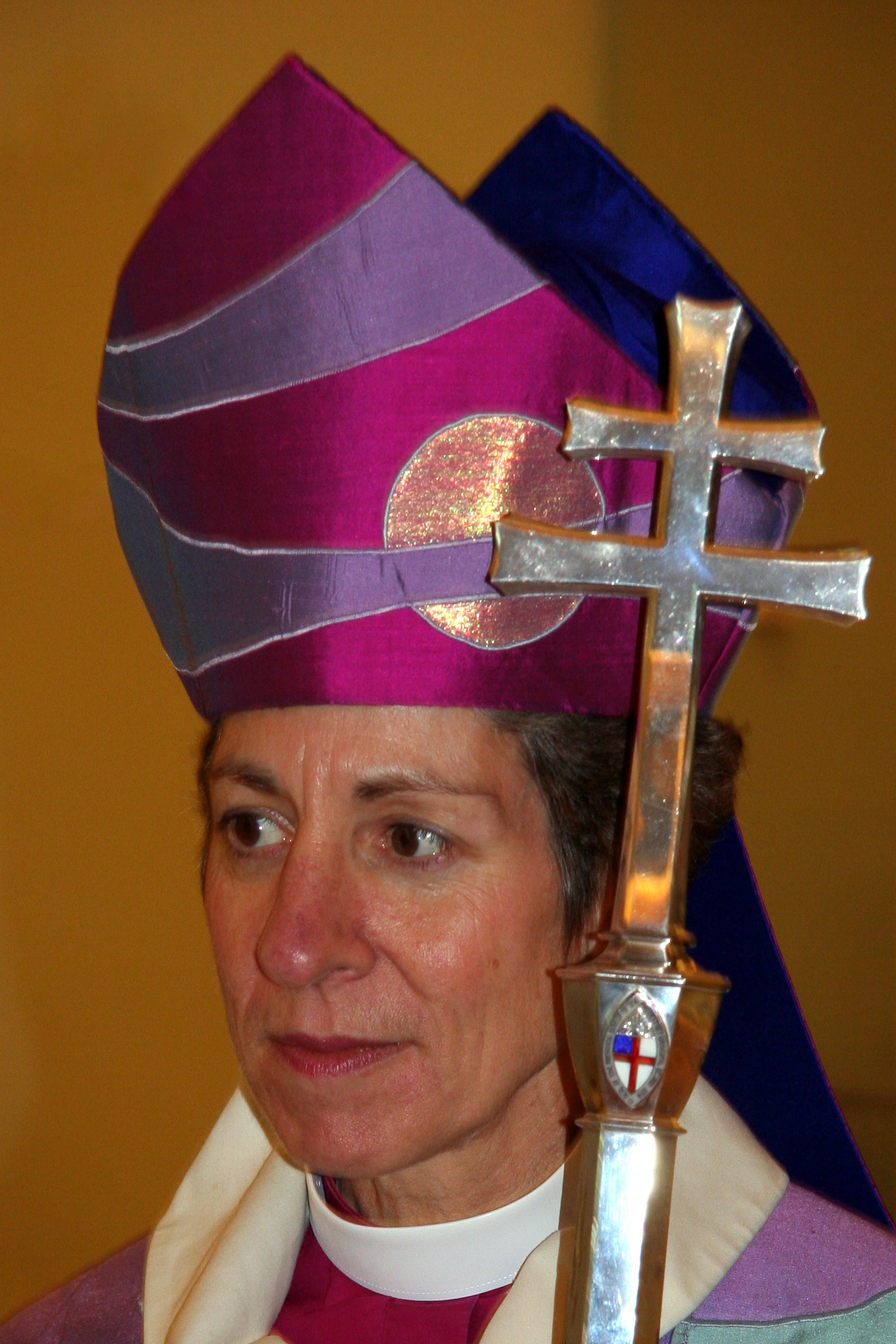 |
| Most Revd Katharine Jefferts Schori Chief Pastor and Primate ECUSA |
Apostolic Women, Apostolic Authority ed. Percy, Rees and Gaffin, Canterbury Studies in Anglicanism is a good read. The articles in it mainly came out of a conference of women bishops, clergy and lay leaders at Ripon College Cuddesdon around the time of the Lambeth Conference 2008. I was intrigued by Emma Percy's 'What Clergy Do, Especially When It Looks Like Nothing.' She compares the ministry of parish clergy with learning to be a mother. Based on the research of Naomi Stadlen, she argues that, as with mothers, a lot of what clergy do looks straightforward, even instinctive, and it is quite difficult to articulate exactly what has been achieved. Yet, just as we notice disturbed, unhappy children, we notice unhappy congregations. The parallels Percy develops between motherhood and priesthood are interesting - two 'jobs not like other jobs'. She writes, for example, about the skills involved in taking the story of an unknown person and, working with the family during a pastoral visit, creating the narrative picture that speaks of the person's uniqueness at their funeral. She highlights the ability most clergy have to shift between different contexts and 'modes of being' in the course of a day; from a big funeral to a finance meeting to a toddler group to an adult study group. Being truly present in each of these circumstances demands the kind of letting go of other things that may be on one's mind that caring for a young child so often requires. The book also has the results of Revd Canon Jane Hedges' research on attitudes to women in leadership in the Church of England and the sermon delivered by The Most Revd Katherine Jefferts Schori (pictured above) at the conference.
Subscribe to:
Posts (Atom)