Did any of you watch the programme in which Rowan Williams said Goodbye to Canterbury over the New Year? I think it was a BBC 2 production. In it, he took the viewer round Canterbury cathedral and spoke very movingly about what it had been like to live with the building over the past ten years. It is a place where you cannot but be conscious of history in the making, a place that reminds you that even the most seemingly permanent things change and a place of incessant pilgrimage. It looks two ways - inwards to Britain and outwards to mainland Europe and beyond. The most moving bit was, for me, when he spoke about what it does to you to have to preside at the eucharist in the place and on the date when one of your predecessors was brutally murdered. It must be difficult to live humbly and calmly with the spectre of Beckett's martyrdom yearly, if not daily before your eyes.
The programme set me thinking about what the buildings and places we worship in do to us. How do they shape what we focus on in worship, what we see as important (or perhaps don't see) and what we think about ourselves and our place in the order of things? I was, for a number of years, Priest-in-Charge of St Patrick's church in Nuthall, Nottingham. Anne Ascough (of Fox's Martyrs fame) lived in the village for a while before her marriage. She espoused the Reformers' ideas and was said to have read scripture, in English, from the lectern in Lincoln cathedral. She became a member of the Queen's court and a lay preacher but was eventually (aged around 24) tortured, tried and executed at the stake for her theological leanings in a plot that was really aimed to flush out Katherine Parr's Protestant sympathies and remove her from her position as Queen. Once I knew the story of Anne, I could never read from the lectern in Nuthall without thinking of her and what she and people like her had gone through so that we can read the Bible in our own language. I used to feel very ashamed of myself if I had not prepared my sermon properly in a way that I haven't quite done before or since. It seemed somehow deeply disrespectful to treat scripture lightly in the shadow of Anne's presence.
I think all the buildings I have worshipped in regularly over the years have had quite a profound influence on the person I have become. The fourth century foundation and early manuscripts of one church spoke inspirationally of the connection of our faith to its origins; the lack of imagery and the plain furniture and decor of another chapel focused me on the word, both scriptural and rational, and taught me not to leave my intellect behind when worshipping; the constant vandalism against the church buildng in another place focused the whole Christian family outwards to care beyond the bubble of church life and to campaign and work for social justice that was specific and tangible. My present job as an archdeacon means that I live the life of contrasts - one Sunday caught up in wonder by the possibilities of transcendence held out in the splendour of a vast building with a wonderful choir, another Sunday humbled and touched by the sincerity of a tiny gathering which materialises determinedly and courageously from the flood and fog-clad countryside. One Sunday, caught up suddenly in the realisation that about the same number of people would have been engaged in Prayer Book worship in that very church nearly 400 years ago, using the words we are using and sitting where we are sitting, gazing at the hills framed by the East window and a great oak tree. Another Sunday feeling the excitement of being part of a group worshipping together for the first time in a cricket club bar with the staff pulling pints and looking on in some puzzlement.
How does your church building challenge you and tangle with your life?
Showing posts with label church buildings. Show all posts
Showing posts with label church buildings. Show all posts
Friday, 4 January 2013
Monday, 5 November 2012
Inspiring Churches
This looks like a really stimulating and informative training day for churches who want to think about the use of their building in the widest sense - from maintenance to social welfare projects, from heritage to environmental issues, from funding to asset management. Make sure you send someone (or perhaps a couple of people) from your PCC if you are engaged in a building project already or if you feel your building could be made better use of or if you think that your church could be more of a resource for local social action. The day is a joint venture with Bradford and Wakefield Dioceses and will, I hope, be a taster of the kind of training resources utilizing both national and regional expretise that we will be able to offer through the three dioceses working together. The Key-note speaker is author and church development consultant Maggie Durran; our own Kathryn Fitzsimons (Urban Officer, Ripon and Leeds) will be contributing one of the workshops. There is a great line up of other experts too. Don't miss this opportunity to think about how you can develop your church building ansd tyo obtain some very practical advice! BOOK NOW online at
PLEASE NOTE THIS DAY HAS BEEN POSTPONED UNTIL 9TH FEBRUARY. IF YOU HAVE BOOKED,THE ORGANISERS WILL BE IN TOUCH. IF YOU HAVE NOT BOOKED THERE IS STILL TIME TO DO SO.


Friday, 5 October 2012
Chancel Repair Liability (2)
There is a very helpful site for PCCs investigating Chancel Repair Liability and struggling with the actual research or the implications of discovering they have lay rectors. Three cheers for Greg Yerbury, A Team Rector in Penkridge, Staffordshire for his excellent work on this! If you visit his website, no. 2 under handouts (PCC Action Sheet) is really useful. I, for one, will be sending a contribution to Greg's PCC to thank him for all the work he has done on this
Monday, 17 September 2012
Metal Theft Prevention
I have received information about a Sheffield-based charity called People Against Crime. It is part-funded by Yorkshire and Humber Police Forces and the European Union. It provides free crime prevention surveys to Faith and Heritage sites including churches. The reports take the form of a written assessment with recommendations about the security of the building and how it can be improved. This is particularly relevant to lead theft from the roof.
Recommendations are cost-effective and suitable for the site surveyed. There is no cost for the service. You can read about the partnership on their website. Contact my office if you would like more details about how to get in touch with the local representative.
| Yorkshire and Humber People United Against Crime | |
| A partnership of Yorkshire and Humber people,
companies and agencies working together to develop strategies for dealing with
crime and its effects on individuals and the community as a whole. Company
limited by guarantee no 3144166 and a registered charity. | |
| http://www.people-united.org | |
|
| |
|
 Address:
  Disabled Access Details: Wheelchair Accessible; Wheelchair
Accessible Toilet
Disabled Access Details: Wheelchair Accessible; Wheelchair
Accessible ToiletFriday, 24 August 2012
Chancel Repair Liability
Some of you may have seen the article in the Telegraph (July 2012) about Chancel Repair Liability. I have received a number of enquiries as a result and so I thought it would be helpful to clarify the situation.
What is Chancel Repair Liability?
·
Your church’s Terrier
·
The local Records Office
·
The National Archives at Kew in a document called the Tithe Redemption Commission Record of
Ascertainments (1936) index no. IR104/107-8
·
The Diocesan Registry
Some Chancel Repair Liabilities are individually held by Lay Rectors.
Others are corporately held (eg. in the case of the Church Commissioners, a
college or a cathedral.) Once you have identified the existence of a lay
rector(s) or a corporate liability, the PCC should discuss the line of action to
be taken. Most of the publicity that has arisen has been around the liability
of individuals who do not have the means to fulfil their responsibility under
law. Such cases give rise to moral and pastoral dilemmas for PCCs. Legal advice should be sought in all such cases. It is essential
that all PCC discussions of Chancel Repair Liability and any resolutions be
fully recorded in the PCC minutes. In most cases, discovery of Chancel Repair
Liability will lead to registration at the Land Registry.
http://www.nationalarchives.gov.uk/ (type chancel repair liability into their search box)
The address of the National Archive is
The National Archive,
Kew,Richmond,
Surrey
TW9 4DU
Postscript; Simon Martin of the Arthur Rank Centre has sent in another two very helpful links to advice on the Arthur Rank Centre Site, though I must stress this is not only an issue for rural churches! http://bit.ly/PBN52S
http://www.arthurrankcentre.org.uk/publications-and-resources/rural-church-buildings
Thursday, 24 May 2012
Saturday Heritage Days
I have been sent information on what promise to be three a really interesting days to help you explore ways to understand how local heritage impacts on the here and now of our communities. Try as I might I could not convert this into a format that is easy to read. Click on the image and it will enlarge so you can get the information you need to book into one of the workshops in Barnsley (26th May), Oldham (16th June) or Huddersfield (30th June). Or contact
r.f.light@hud.ac.uk tel. 01484 478408

Saturday, 5 May 2012
Saxon Kirk Hammerton


As its name might suggest, the church in the village of Kirk Hammerton, between York and Boroughbridge, is Saxon in origin. The church, signposted 'ancient church' from the A59 welcomes visitors.


Situated on a mound in the centre of village, the church of St John the Baptist has areas dating from 600-800 ( south nave and chancel) and from around 1,000AD (tower and west door).


The Diocesan Tourism Group is busy working on a Saxon trail to take in sites around the area that are of Saxon origin or have Saxon artefacts. Beginning with the crypt at Ripon cathedral (672) you can spend a long summer day visiting some of these delightful ancient sites - Masham (Saxon burials), West Witton, Staveley, Goldsborough, Follifoot, Spofforth, Harewood and Collingham, Bardsey. A big thank you to the Revd Paul Spurgeon for talking to us about the church at Kirk Hammerton - not simply its history but also giving us an insight into the way the church has been developed dwon the centuries and the part it plays in village life today.
Sunday, 1 April 2012
Ripon Cathedral as Never Seen Before

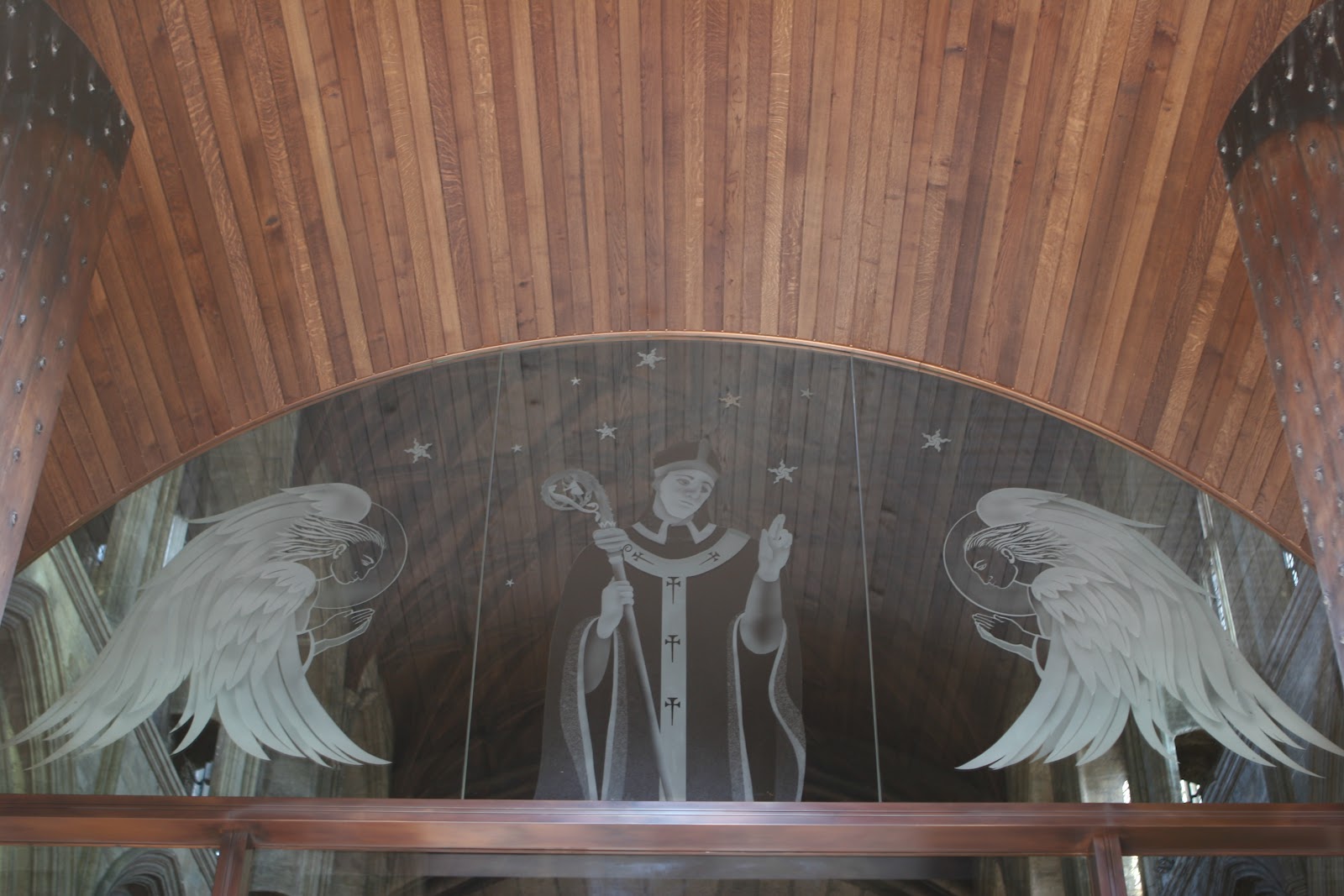
Ripon Cathedral has completed its Narthex project in good time for Holy Week. The new internal glass porch and doors mean that light now floods into the West end of the building and the interior of the cathedral can be seen from Kirkgate making it much more welcoming to the approaching pilgrim. Regular worshippers are seeing features of the building they have never noticed before! If you are near enough, come and see for yourself - the effect is stunning! The contractors were Anelays of York, the architect is Oliver Caroe of Caroe Architecture, Cambridge and the artist who designed the etching on the glass panels above the doors is Sally Scott. The panels were executed at Nero Design Studios, London. The etchings depict the life of St Wilfrid. For more photos, reaction and comments visit
for the story of the project, visit



Saturday, 31 March 2012

Sunday, 18 December 2011
Hidden Corners at St Gregory's, Bedale
A. Find an enthuiastic guide to show him round the church!
St Gregory's, Bedale As We All Recognize It


Lesser Known Features of St Gregory's as introduced
by Hannah Megson


And finally...
 |
| The new Rector designate, the Revd Ian Robinson |
Ian will be inducted by the Bishop of Ripon and Leeds on 19th April 2012 at 7.30pm
Saturday, 26 November 2011
Living Churchyards
Today I received a list of all the churches in the area that are or have been until recently 'managed for wildlife'. This was sent to me by the Yorkshire Living Churchyard Project which is run by Yorkshire Wildlife Trust. From the list, it seems as though churches were entering into this enthusiastically about 10 years ago but that some have fallen back a little in recent years. If you would like information on how your church can develop its churchyard ('God's Acre') so that the environment is sympathetic to the natural habitat and the ecology of native plants and animal and insect species, go to
Churchyard management seminars are held every year to help people learn more about how to take usually quite simple steps to preserve and encourage the presence of wildlife. Members of the Living Churchyard Team are willing to visit parishes and offer advice. They will list the species seen and heard and create an annotated map of the site to help with planning its care. Often, we just don't realise what we have living in our churchyards! Or what we might be destroying by over-managing them.
Some practical tips
Headstones are important sites for lichen and mosses, depending on the type of stone. There are around 300 different types of lichen found only in British churchyards. Headstones should not be cleaned (for example, with some of the sprays advertised for the purpose!), but left undisturbed. Grass should not be cut too close to the base of headstones as this may damage both the stone and the equipment used for mowing, and, in fact, the longer grass left at the base provides shelter for some small animals such as frogs.
Boundary hedges are the natural habitat of many species of bird and small mammals. Hedges are best trimmed to an 'A' - thicker at the bottom - with a few feet of uncut grass at the base. This provides shelter and food sources for young hedgehogs. The small ferns and mosses that grow on boundary walls are important. Where walls need restoration, if this is done in sections plants can gradually recolonize the wall. Lime mortar should be used wherever possible.
Trees and shrubs provide nesting sites, look-out posts and insects for birds. Native species should be planted, preferably those that grow naturally in the surrounding countryside. Shrubs that bear berries and nuts such as hawthorn, holly and hazel are valuable for food. Ivy provides nesting sites for wrens and, later in the year, nectar and berries after other food sources have been used up.
Many churchyards were created out of meadowland and provide a natural refuge for species of plants and animals that are being lost through intensive farming. Even a small churchyard may contain over 100 different species. Bees, butterflies, moths, frogs, lizards, birds and small mammals find their home territory there and, where sections of the churchyard are left as meadowland or long grass, rarer plants may move in, such as cowslips and early purple orchids, especially where traditional methods of cutting or grazing have meant that fertilizers and persticides have not been used. Most churchyards have sections of close-mown grass around paths and frequently visited graves. Less frequently visited parts of the churchyard may be kept as permanent short grass (about 4-5 inches) and cutting should be avoided in early May to allow for flowering and seeding. It is also a good idea to create areas of permanent long grass around the churchyard though, to avoid scrub invasion and maintain grass species, these should be divided into sections and a different section cut in autumn of each year. These areas of long grass are important for the overwintering of moth eggs and pupae, frogs, lizards shrews and voles.
Spring meadow plants
bird's foot trefoil, cat's ear, red clover, cowslip, lady's smock, bugle
Summer meadow plants
meadow buttercup, meadow cranesbill, ox-eye daisy,knapweed, field sabacious,
yarrow
Hay and grass cuttings
Grass cuttings should be removed if at all possible, to prevent the smothering of smaller flowering plants and to avoid changing the soil composition as the grass decays. Hay cannot be used for livestock if it contains plants harmful to animals such as ragwort. Local councils may operate a composting scheme. If they do not, cuttings are best made into small compost heaps by mixing with the grass with other biodegradable materials such as twigs and pruning waste. This allows air to circulate. Compost left near trees can cause damage to the tree roots. Compost heaps are home to bacteria and invertibrate animals that provide food for frogs, toads, slow worms and birds. Hedgehogs and other small mammals hibernate in them .
Churchyard management seminars are held every year to help people learn more about how to take usually quite simple steps to preserve and encourage the presence of wildlife. Members of the Living Churchyard Team are willing to visit parishes and offer advice. They will list the species seen and heard and create an annotated map of the site to help with planning its care. Often, we just don't realise what we have living in our churchyards! Or what we might be destroying by over-managing them.
 |
| Muker Churchyard, Swaledale |
Headstones are important sites for lichen and mosses, depending on the type of stone. There are around 300 different types of lichen found only in British churchyards. Headstones should not be cleaned (for example, with some of the sprays advertised for the purpose!), but left undisturbed. Grass should not be cut too close to the base of headstones as this may damage both the stone and the equipment used for mowing, and, in fact, the longer grass left at the base provides shelter for some small animals such as frogs.
Boundary hedges are the natural habitat of many species of bird and small mammals. Hedges are best trimmed to an 'A' - thicker at the bottom - with a few feet of uncut grass at the base. This provides shelter and food sources for young hedgehogs. The small ferns and mosses that grow on boundary walls are important. Where walls need restoration, if this is done in sections plants can gradually recolonize the wall. Lime mortar should be used wherever possible.
Trees and shrubs provide nesting sites, look-out posts and insects for birds. Native species should be planted, preferably those that grow naturally in the surrounding countryside. Shrubs that bear berries and nuts such as hawthorn, holly and hazel are valuable for food. Ivy provides nesting sites for wrens and, later in the year, nectar and berries after other food sources have been used up.
Many churchyards were created out of meadowland and provide a natural refuge for species of plants and animals that are being lost through intensive farming. Even a small churchyard may contain over 100 different species. Bees, butterflies, moths, frogs, lizards, birds and small mammals find their home territory there and, where sections of the churchyard are left as meadowland or long grass, rarer plants may move in, such as cowslips and early purple orchids, especially where traditional methods of cutting or grazing have meant that fertilizers and persticides have not been used. Most churchyards have sections of close-mown grass around paths and frequently visited graves. Less frequently visited parts of the churchyard may be kept as permanent short grass (about 4-5 inches) and cutting should be avoided in early May to allow for flowering and seeding. It is also a good idea to create areas of permanent long grass around the churchyard though, to avoid scrub invasion and maintain grass species, these should be divided into sections and a different section cut in autumn of each year. These areas of long grass are important for the overwintering of moth eggs and pupae, frogs, lizards shrews and voles.
Spring meadow plants
bird's foot trefoil, cat's ear, red clover, cowslip, lady's smock, bugle
Summer meadow plants
meadow buttercup, meadow cranesbill, ox-eye daisy,knapweed, field sabacious,
yarrow
Hay and grass cuttings
Grass cuttings should be removed if at all possible, to prevent the smothering of smaller flowering plants and to avoid changing the soil composition as the grass decays. Hay cannot be used for livestock if it contains plants harmful to animals such as ragwort. Local councils may operate a composting scheme. If they do not, cuttings are best made into small compost heaps by mixing with the grass with other biodegradable materials such as twigs and pruning waste. This allows air to circulate. Compost left near trees can cause damage to the tree roots. Compost heaps are home to bacteria and invertibrate animals that provide food for frogs, toads, slow worms and birds. Hedgehogs and other small mammals hibernate in them .
Friday, 11 November 2011
Metal Theft Meeting
 |
| Taken from the http://www.riponleeds.anglican.og/ |
Our Buildings Officer, Alice Ullathorne has organised a meeting at the Diocesan Office in Leeds this coming Wednesday (16th November) which will be very helpful to churches who are concerned about metal theft. The meeting is at 3pm. Representatives of the police, Ecclesiastical Insurance and English Heritage will be present. You can see the details on
http://www.riponleeds.anglican.org/press-416.html
And, if I'm not much mistaken, the picture is one of this archdeaconry's churches (won't say where!)
Monday, 5 September 2011
Lead Theft
Last week, I visited a church where the wardens were at the end of their tether! They had suffered three successive thefts of lead. This is a Grade 1 listed building in a deeply historic setting with a small band of dedicated people who put a huge amount of time and energy into caring for their church building and supporting those who wish to worship and celebrate baptisms and weddings there. Not only have they made many improvements recently, but they are determined to make their church a place of welcome and hospitality for worshippers, visitors and pilgrims. Indeed, as I walked round the church and church yard, there were visitors from Scotland and Australia enjoying the quiet beauty of the place, praying and looking at the various points of historical interest. But there is, quite simply, an end to the amount of money PCCs and villagers can raise to keep replacing lead taken from church roofs - and there is that sinking feeling in the pit of everyone's stomach - not again! Insurers will no longer cover anything more than a first incident of theft; after that, parishes receive only a nominal sum towards what might turn out to be repeated replacements of lead. The experts and the amenity authorities such as English Heritage are beginning to look more favourably at the use of alternative substances in some places.
It makes us all very angry, frustrated and sad that so much completely unnecessary effort goes into just keeping a watertight roof on the church.
For information about how to prevent lead theft go to
http://www.ecclesiastical.com/Images/PDF%20-%20Theft%20of%20metal%20guidance%20notes.pdf
There is a very good check list for churches to use which helps you assess how at risk of theft your church may be. You can download this from the Norwich Diocesan website at
http://www.norwich.anglican.org/buildings/dac/guidance/theft-of-lead
You can also help by signing an e petition asking the government to amend the Scrap Metal Merchants Act 1964 to prohibit cash transactions in the scrap metal industry. Because so much of the trade that goes on in the industry involves cash-in-hand transactions, it is very difficult for the police to identify and trace those who may be involved in selling or purchasing stolen metal. Also, always make enquiries about where lead that is going to be used on your building has come from!
http://epetitions.direct.gov.uk/petitions/406
And finally - if you see anyone on the roof of a church, contact the local priest or church warden straight away (telephone number usually on the church notice board) to make sure they should be there. If you can't get hold of anyone and you suspect they should not be there (it is dark or you know that workmen were not expected) note down the number of their vehicle and ring the police immediately.
It makes us all very angry, frustrated and sad that so much completely unnecessary effort goes into just keeping a watertight roof on the church.
For information about how to prevent lead theft go to
http://www.ecclesiastical.com/Images/PDF%20-%20Theft%20of%20metal%20guidance%20notes.pdf
There is a very good check list for churches to use which helps you assess how at risk of theft your church may be. You can download this from the Norwich Diocesan website at
http://www.norwich.anglican.org/buildings/dac/guidance/theft-of-lead
You can also help by signing an e petition asking the government to amend the Scrap Metal Merchants Act 1964 to prohibit cash transactions in the scrap metal industry. Because so much of the trade that goes on in the industry involves cash-in-hand transactions, it is very difficult for the police to identify and trace those who may be involved in selling or purchasing stolen metal. Also, always make enquiries about where lead that is going to be used on your building has come from!
http://epetitions.direct.gov.uk/petitions/406
And finally - if you see anyone on the roof of a church, contact the local priest or church warden straight away (telephone number usually on the church notice board) to make sure they should be there. If you can't get hold of anyone and you suspect they should not be there (it is dark or you know that workmen were not expected) note down the number of their vehicle and ring the police immediately.
Friday, 19 August 2011
Yorkshire's Monastic Churches as You've Not Seen Them Before!

William Thackray, priest at Scruton, in this diocese, has just produced a book entitled Standing on Holy Ground; Monastic and Collegiate Churches of Yorkshire. The book contains photographs of all the monastic or collegiate foundation churches in Yorkshire from ruins to parish churches, from monasteries to cathedrals, from coast to dale, from urban south to rural north. The photography is breath-taking and this is a book to lose yourself in. During its production, he visited most of the churches throughout the different seasons and so the selection of photographs of many of the sites reflects the rhythm of both the natural seasons and the Christian year. The photographs capture the unique atmosphere of each place and, in many instances, communicate something of the essence of the communities who inhabit them today for worship, pilgrimage and celebration. Also included are brief histories of the buildings with stories of the communities who have inhabited them down the centuries, portraying the heights and depths of faith and folly. He has produced similar books on the churches of York city centre and the churches of the City of London.
If you are interested in seeing more, William Thackray is available to give illustrated presentations on the Monastic and Collegiate Churches of Yorkshire, the Churches of York City Centre and the Churches of the City of London. These talks last anything from half an hour to an hour and a half, depending on the nature of the group. This is an excellent resouce for schools, MU and WI groups, local history societies and other organisations who are looking for speakers. There is no charge. Expenses and a donation to the Chidren's Society would be welcome.
If you would like further details send a message to

Sunday, 31 July 2011
Mediaeval Church Interiors - the Wow Factor!
 |
| The Church of St Teilo at St Fagan's Museum, Cardiff |
The exterior of this plain little church, dating from the twelfth century, hides a stunning secret. It is the church of St Teilo which, until the 1970's, was situated on the banks of the River Clwchwr at Llandeilo Tal-y-Bont, near Pontardulais. It ceased to be a parish church in the 1850's and became increasingly damp and delapidated so that worship was all but impossible. The final service was held in 1970 and the building was carefully demolished and brought to St Fagan's Museum of Welsh Life (the National History Museum) in Cardiff where it was painstakingly reconstructed, stone by stone. However, as this ancient building was taken down, it revealed an unexpected surprise. As the layers of paint and plaster were removed, 500 year old wall paintings were discovered depicting many aspects of the life of Christ and the lives of the saints. When the church was rebuilt at St Fagan's, it was decided that the walls should be painted to appear as they would have looked in 1520. Visitors to the church now walk into a building which looks much as it would have in the Middle Ages. The impact is breath-taking and provides a powerful reminder that Mediaeval churches were full of images which told the Christian story for largely illiterate congregations. We have a wonderful example of the use of such wall paintings in this area at St Agatha's church, Easby, near Richmond; there, in the chancel you can still see the original paintings of the Fall, on one side, and the cross and resurrection - the remedy for the Fall - on the opposite side. In today's society where image is once again such an important feature of communication , it seems a shame that this element of church interior decoration has largely been abandoned. We are perhaps missing an opportunity to tell the Christian story, to inculturate or localize aspects of it (as the church has always done) and to utilize contemporary art forms to do so.
 |
| The South Porch |
 |
| The Rood Screen |
 |
| Christ at the Last Supper with the Apostles |
 |
| Christ Carrying His Cross |
 |
| Christ Being Taken Down From the Cross |
 |
St Catherine
|
Saturday, 28 May 2011
No Village Shop?
We were recently visiting family in Devon and I was impressed to find a very well stocked and managed community shop in the tiny village where we stayed. As well as offering Post Office services, there were a couple of tables where you could sit to have a cup of coffee and read the newspaper or to hold a meeting - business or pleasure. The lady in charge told us that this 'cafe' style service was proving a popular addition and people could make their own drinks if staff were busy. It set me thinking how, for a fairly small sum of money and with a bit of imagination, many churches could offer the facilities for a community shop. This would certainly bring the church (people and building) more into the centre of community life and enable the church to provide a hospitable forum for the many connections and partnerships that are at the heart of any local community. In her introduction to the Big Society last night at Bedale, Alice Ullathorne (our Buildings Officer) introduced us to some valuable resources for thinking about this kind of project. She also told us the story of churches where rural shops had been set up in the Chelmsford and St Albans areas. The cost in one case was surprisingly low (£10,000); the 'cost' was, in fact, more accurately measured out in the time and effort to bring people together to share the vision and then set up and run the enterprise. Profits go to local charities.
Useful resources
Crossing the Threshold; A Community Development Approach to the Use of Church Buildings by Simon Whaley
http://www.simonwhaley.co.uk/2011/02/crossing-the-threshold
Guidelines and Best Practice for the Setting Up of Community Shops in Churches and Chapels
http://www.churchcare.co.uk/pdf_view.php?id=173
Guidelines and Best Practice for the Provision of a Hosted Post Office in Churches and Chapels
http://www.churchcare.co.uk/pdf_view.php?id=31
Many thanks to Alice for the resources and helpful insights she shared with those who attended the seminar on the Big Society, last night. We need more discussion of the changes in thinking that these developments are going to necessitate. The current changes in political outlook about the provision of many services are quite radical and are going to create new ways for churches to relate to their communities. They may bring about a return to some of the needs and opportunities the churches took a lead in responding to before the creation of the Welfare State (especially in social care). We need to keep a close eye on developmets and on what is being asked and offered in the way of grants and commissions.
Useful resources
Crossing the Threshold; A Community Development Approach to the Use of Church Buildings by Simon Whaley
http://www.simonwhaley.co.uk/2011/02/crossing-the-threshold
Guidelines and Best Practice for the Setting Up of Community Shops in Churches and Chapels
http://www.churchcare.co.uk/pdf_view.php?id=173
Guidelines and Best Practice for the Provision of a Hosted Post Office in Churches and Chapels
http://www.churchcare.co.uk/pdf_view.php?id=31
Many thanks to Alice for the resources and helpful insights she shared with those who attended the seminar on the Big Society, last night. We need more discussion of the changes in thinking that these developments are going to necessitate. The current changes in political outlook about the provision of many services are quite radical and are going to create new ways for churches to relate to their communities. They may bring about a return to some of the needs and opportunities the churches took a lead in responding to before the creation of the Welfare State (especially in social care). We need to keep a close eye on developmets and on what is being asked and offered in the way of grants and commissions.
Sunday, 20 February 2011
The English Parish Church
I thoroughly enjoyed Richard Taylor's insights into the significance of the English parish church (BBC2 Friday evening Churches, How to Read Them.) Searching behind our Victorian and post Reformation history, we find inspiration for returning parish churches to the centres of life that they once were, embracing every aspect of daily life and offering protection and assistance from the cradle to the grave.
How does this sound - games, children playing and drama in church, sports and fayres in the churchyard, business transacted and courts held in the porch, cartoons (in their time) of bible stories and theological truths in the frescos on the walls, and areas of the church given over to special uses - for children, for baptisms, for churchings (women giving thanks after childbirth) and for trading and holding meetings. In particular, Taylor showed us a marvellous font in a Herefordshire church which depicted the whole story and theology of Jesus' baptism. He also showed us an area of a church with beautiful images of mothers and of St Margaret, the patron saint of chidbirth, where women had come to pray for strength and safe delivery before giving birth. Apparently, unidentified corpses were laid out in some church porches so that families could claim their mssing dead. The church was the place people naturally came for help, advice, support and in times of personal difficulty.
Some parishes are beginning to return their churches to the community in exciting new ways and to welcome a rich diversity of events to take place there. A few have never stopped being places of gathering for the whole community. Others are more cautious and the fragrace of 'reverence' and severity pervades at all times - there is not a square inch without a pew in which to do anything! In the last parish where I worked as a parish priest, we used to hold our annual church festival in the churchyard in and among the graves. One or two people commented that it seemed a bit irreverant but most people welcomed the convivial atmosphere and thought that it was good to mix life with a remembrance of those who had once lived and enjoyed such events in their village. We also had games sessions for toddlers in church, often pausing to marvel, through a three year's eyes, at some of the artefacts in the church. Again, not everyone approved but the number of young families attending church improved dramatically! Many of the churches I visit now have special places set aside for prayer with candles, prayer trees and other prayer aids. Spaces for young children (some more convivial than others) are quite common, as are areas for exhibitions, infomation, art work and local photography. One or two churches even have places where visitors can make themselves a cup of tea. And I'm glad to say that a very large number of our country parish churches are open in the daytime.
In our generation, we tend to be rather shy of using churches for business (unless they are redundant and have been turned into carpet warehouses or pottery shops!) But medieval churches were places where a lot of business was carried out and where people came for justice and for education and information. People also caught up on gossip and ate in the nave. If you walked to a morning service and stayed for the evening service, you needed somewhere to shelter and eat in between. Personally, it always gladdens my heart when I discover churches that offer services the community needs, values and enjoys, even where this leads to money changing hands and crumbs in the transepts! It is also great to see churches used for lectures and meetings and these do not always need to be religious ones! It is all about balance and the PCC retaining proper control of the building so that at times when the building needs to provide a quiet, dignified and reverential atmosphere, this can be achieved.
A few months ago, I took services at Downholme and Marske and I was moved by a deep sense, in both churches, that here were about 16 or 20 of us worshipping very much in the way that people had worshipped at the Reformation and even before it. Yes, some of the words had changed and, yes, the music had changed but, essentially, there had probably been a couple of dozen people from these villages saying their prayers together, celebrating Holy Communion and marking the joys and sorrows of people's lives in these sacred spaces for the past several hundred years. Box pews, pulpits and sanctuary spaces had changed, but the sense of the life of the community flowing through the church had not changed and nor had the expectation of meeting with God here. Nor, I suspect, had the fact that most of the village were not in fact present!
Let's find every way we can to open our churches up to people, to make them welcoming, interesting, enjoyable places to be!
You can view Richard Taylor's program on
http://www.bbc.co.uk/iplayer/episode/b00tp1cs/churches_how_to_read_them_medieval_life
 |
| St Michael's Downholme |
Some parishes are beginning to return their churches to the community in exciting new ways and to welcome a rich diversity of events to take place there. A few have never stopped being places of gathering for the whole community. Others are more cautious and the fragrace of 'reverence' and severity pervades at all times - there is not a square inch without a pew in which to do anything! In the last parish where I worked as a parish priest, we used to hold our annual church festival in the churchyard in and among the graves. One or two people commented that it seemed a bit irreverant but most people welcomed the convivial atmosphere and thought that it was good to mix life with a remembrance of those who had once lived and enjoyed such events in their village. We also had games sessions for toddlers in church, often pausing to marvel, through a three year's eyes, at some of the artefacts in the church. Again, not everyone approved but the number of young families attending church improved dramatically! Many of the churches I visit now have special places set aside for prayer with candles, prayer trees and other prayer aids. Spaces for young children (some more convivial than others) are quite common, as are areas for exhibitions, infomation, art work and local photography. One or two churches even have places where visitors can make themselves a cup of tea. And I'm glad to say that a very large number of our country parish churches are open in the daytime.
In our generation, we tend to be rather shy of using churches for business (unless they are redundant and have been turned into carpet warehouses or pottery shops!) But medieval churches were places where a lot of business was carried out and where people came for justice and for education and information. People also caught up on gossip and ate in the nave. If you walked to a morning service and stayed for the evening service, you needed somewhere to shelter and eat in between. Personally, it always gladdens my heart when I discover churches that offer services the community needs, values and enjoys, even where this leads to money changing hands and crumbs in the transepts! It is also great to see churches used for lectures and meetings and these do not always need to be religious ones! It is all about balance and the PCC retaining proper control of the building so that at times when the building needs to provide a quiet, dignified and reverential atmosphere, this can be achieved.
 |
| St Edmund's, Marske |
Let's find every way we can to open our churches up to people, to make them welcoming, interesting, enjoyable places to be!
You can view Richard Taylor's program on
http://www.bbc.co.uk/iplayer/episode/b00tp1cs/churches_how_to_read_them_medieval_life
Subscribe to:
Posts (Atom)