Showing posts with label art. Show all posts

Saturday, 21 July 2012

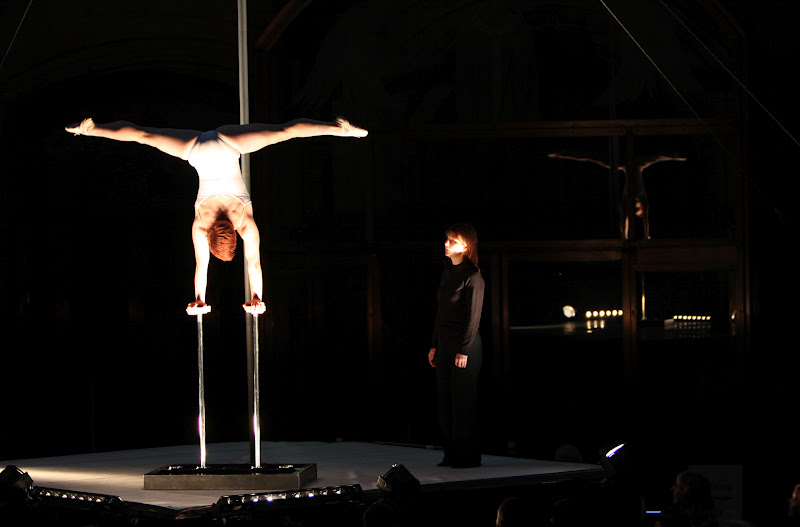
How Like An Angel at Ripon Cathedral

Bringing together Circa and I Fagiolini, two inspiring groups of artists in contemporary circus and vocal music. The third partner in the performance is the unique architecture and history of each cathedral where it is performed.

CIRCA originates in Brisbane, Australia, bringing us a daring new vision of circus, blending bodies, light, sound and artistry - this is the human body at its extremes of endurance, strength and versatility. 'Stunning., heart-stopping, unbearably beautiful.'

I FAGIOLINI is a group of vocal musicians rooted in the repertoire of the Renaissance and Baroque periods but also performing contemporary music. The sound moves around the building (as do the performers) and the quality of each individual voice and of the ensemble is arresting. Renaisssance polyphony at its stunning best in a building which lends itself to the form.
To hear a promotion for I Fagiolini's new show Tallis in Wonderland and to gain an insight into the aural quality of this performance go to

Circa Director Yaron Lifschitz
I Fagiolini Director Robert Hollingworth

Photos from Ripon Cathedral David M. Challoner


Tuesday, 6 December 2011

New Beginnings

Spiritual Director - 'Just try getting some crayons out.'
Janet - 'Oh no, I really don't do art.'

It was liberating!! Try something new this Advent!


Ser dros Yr Wyddfa


Ichthyan Odyssey


For Art Lovers


The question of what Art speaks to you and inspires you is a very culturally dependent and subjective thing. One of the modern sculptures I like best in any church is Jonathan Clarke's Way of Life in the West tower of Ely Cathedral. It was commissioned about fifteen years ago by the Friends of Ely Cathedral, the Dean and Chapter and the Cambridge-based Theology Through the Arts Project. I don't think I can post an image without infringing copyright, but you can see it at
 www.flickr.com/photos/fizikal_rex/3862526344/in/set-72157616580968572

My eye was caught recently by news of a new £10,000 prize to be awarded by the Jerusalem Trust for the best developed proposal for a new work of art in a church. Could your church be the one to convince the judges that you can capture something unique in a piece of art specially created for your church and enhancing the experience of worshipper, pilgrims and casual visitors who come? The Theology Through the Arts project had a very special way of working in that it brought together small clusters of artists and experts to collaborate closely - an artist, theologian and dancer or a librettist, theologian and musician, for example. I think that this is an extremely successful and illuminating way to promote the kind of creativity that expresses deep truth.

The poster above gives the the information you will need about the competition and may I invite you to think further and certainly to contact Diana Coulter at the Cathedral and Church Buildings Division dianacoulter@churchofengland.org  if you are interested in knowing more? Go on, have a go! You can also read about the things you need to consider in commissioning a new work of art in this publication  

Published by the Archbishops' Council
Cathedral and Church Buildings Division

http://www.churchcare.co.uk/

Saturday, 27 August 2011

Auschwitz Project at Henshaws

Henshaw's Arts and Crafts Centre, Knaresborough, is currently hosting an exhibition of art work produced by disabled activist, Di Lofthouse MBE. Working closely with artist Shaeron Caton-Rose, Di has created an extremely powerful group of works expressing her response to a visit to Auschwitz, last summer. Those murdered at Auschwitz, of course, included many people who were sent to the camp because they were deemed disabled. In this exhibition, Di expresses her reaction to what she saw in paintings, prints, sculpture and film through which she explores the theme of humanity in the face of atrocity. Her belief in the dignity of every individual 'whatever skin you live in' has long informed her campaigning and is a prime motivational force in this very moving exhibition. Part of the exhibition can also be taken on tour and is suitable for schools and other educational groups. It would particularly fit the history and PSHE curricula, dealing, as it does in a very powerful way, with issues to do with respect and human rights.

I have visited the exhibition and found it sobering yet hopeful. The Revd Elizabeth Sewell, the Team Rector of the Knaresborough Team of churches writes, 'This exhibition at Henshaws is amazing! Very powerful in its own right but also an opportunity (I think) to explore ability rather than disability.' It closes on 2nd September, so get over to see it this week if you can, especially if you think the touring version might be a resource for your school or church.

For information about the exhibition

http://www.henshaws.org.uk/arts-and-crafts-centre/events/2011/07/18/exhibition-the-auschwitz-project

Di Lofthouse, the artist

http://www.selfdirect.org/blog/profile21/di-lofthouse-mbe.html

in conjunction with Shaeron Caton-Rose

http://www.nyos.org.uk/Artist.aspx?id=208

Friday, 19 August 2011

Yorkshire's Monastic Churches as You've Not Seen Them Before!


William Thackray, priest at Scruton, in this diocese, has just produced a book entitled Standing on Holy Ground; Monastic and Collegiate Churches of Yorkshire. The book contains photographs of all the monastic or collegiate foundation churches in Yorkshire from ruins to parish churches, from monasteries to cathedrals, from coast to dale, from urban south to rural north. The photography is breath-taking and this is a book to lose yourself in. During its production, he visited most of the churches throughout the different seasons and so the selection of photographs of many of the sites reflects the rhythm of both the natural seasons and the Christian year. The photographs capture the unique atmosphere of each place and, in many instances, communicate something of the essence of the communities who inhabit them today for worship, pilgrimage and celebration. Also included are brief histories of the buildings with stories of the communities who have inhabited them down the centuries, portraying the heights and depths of faith and folly. He has produced similar books on the churches of York city centre and the churches of the City of London.

If you are interested in seeing more, William Thackray is available to give illustrated presentations on the Monastic and Collegiate Churches of Yorkshire, the Churches of York City Centre and the Churches of the City of London. These talks last anything from half an hour to an hour and a half, depending on the nature of the group. This is an excellent resouce for schools, MU and WI groups, local history societies and other organisations who are looking for speakers. There is no charge. Expenses and a donation to the Chidren's Society would be welcome.

If you would like further details send a message to 


Sunday, 31 July 2011

Mediaeval Church Interiors - the Wow Factor!


The Church of St Teilo at St Fagan's Museum, Cardiff

The exterior of this plain little church, dating from the twelfth century, hides a stunning secret. It is the church of St Teilo which, until the 1970's, was situated on the banks of the River Clwchwr at Llandeilo Tal-y-Bont, near Pontardulais. It ceased to be a parish church in the 1850's and became increasingly damp and delapidated so that worship was all but impossible. The final service was held in 1970 and the building was carefully demolished and brought to St Fagan's Museum of Welsh Life (the National History Museum) in Cardiff where it was painstakingly reconstructed, stone by stone. However, as this ancient building was taken down, it revealed an unexpected surprise. As the layers of paint and plaster were removed, 500 year old wall paintings were discovered depicting many aspects of the life of Christ and the lives of the saints. When the church was rebuilt at St Fagan's, it was decided that the walls should be painted to appear as they would have looked in 1520.  Visitors to the church now walk into a building which looks much as it would have in the Middle Ages. The impact is breath-taking and provides a powerful reminder that Mediaeval churches were full of images which told the Christian story for largely illiterate congregations. We have a wonderful example of the use of such wall paintings in this area at St Agatha's church, Easby, near Richmond; there, in the chancel you can still see the original paintings of the Fall, on one side, and the cross and resurrection - the remedy for the Fall - on the opposite side. In today's society where image is once again such an  important feature of communication , it seems a shame that this element of church interior decoration has largely been abandoned. We are perhaps missing an opportunity to tell the Christian story, to inculturate or localize aspects of it (as the church has always done) and to utilize contemporary art forms to do so.   

The South Porch
The Rood Screen
Christ at the Last Supper with the Apostles
Christ Carrying His Cross
Christ Being Taken Down From the Cross
St Catherine
St Teilo was a Welsh saint, a contemporary of St David and St Padarn. It is said that he went on a pilgrimage to Jerusalem where he was consecrated bishop.

Friday, 22 July 2011

A Very Norwegian Place to be


The Norwegian Church, Cardiff Bay

http://www.norwegianchurchcardiff.com/

We spent a very interesting few hours at the Norwegian Church in Cardiff Bay, yesterday. Built on Bute Dock in 1868 for the many service men who sailed into Cardiff Bay in an age when Cardiff exported more coal than any other port in the world, the little wooden church is still a distinctive feature of the sky line in Cardiff Bay. Originally it both provided a place to relax and write home for the many Norwegian sailors who came to Cardiff and also acted as the hub for the thriving local Norwegian community. The church fell into disrepair in the 1960's and 70's but was restored in 1982 by a conservation group whose president was the author, Roald Dahl. Dahl was born in Cardiff, of Norwegian parents. Today, the church, which is within sight of the Senedd (the Welsh Assembley Building), has been newly refurbished and houses a cafe and gallery. It was very poignant to be in the cafe, yesterday, as the news of the terrorist atrocities in Oslo was breaking on the BCC's world news chanel. It brought home to us the importance of such missions to seamen all around the world; here was a place where people come together to feel connected with home at times of national anxiety and tragedy as well as at times of rejoicing. Our heart goes out to the people of Norway, a nation well known for its exemplary tradition of democracy. 

The gallery at the church is currently hosting a facinating exhibition of photographs illustrating the message of each of the 66 books in the Bible. Masterminded by Owen Brown, the exhibition marks the 400th anniversary of the King James Bible. I quote from the book which accompanies the exhibits, a paragraph which I think reflects the location of the exhibition at the heart of one of the ports that shaped the Britain and America of the nineteenth and twentieth centuries. 

'You may think our modern world is founded on secular ideals, but arguably the translation of the Bible not only influenced the English language and literature more than any other book, it was also the seedbed for Western Democracy, the driver for the abolition of the slave trade, the shaper of the British legal system and the framework for the Christian culture of both the British and American empires. And...it is also a book which outsells, is read by more people and is being translated into more languages than any other today.'   

The exhibition takes each book of the Bible and illustrates one verse with a photograph which captures the theme or the flavour of the book. I was struck by the power of this simple idea to communicate something of the essence of the scriptures in a way that gets people thinking and talking and brings out the contemporary relevance of the Bible's themes. You can find more information about the exhibition and see some of its stunning images on


Sunday, 19 June 2011

Newby Hall

Newby Hall, designed by Sir Christopher Wren

A Bevy of Deer by Emma Stothard

Collavoce, Musical Director Catherine Field- Leather
We wandered over to Newby Hall for lunch, yesterday, and found ourselves in the middle of a 'Fun and Frivolity' Day, courtesy of the Musesum of British Folklore. Callavoce were singing madrigals and other summer songs and a wonderful group (whose name I didn't get) were giving displays of folk dancing which were great to watch because the dancers were so obviously thoroughly enjoying dancing! How very lucky we are to have Newby Hall nearby - barely a week passes without some interesting event or exhibition of local skills and crafts. The Compton family whose home the Hall is, have a special interest in art and sculpture. At the moment, you can see Emma Stothard's wonderful willow sculptures with evocative titles like Parliament of Hares and Quadrille of Lobsters.
 Soon to open will be a 'hands on' exhibition by Zimbabwean sculptors like Dudzai Mushawepwere and Matthew Nakawhale mounted by the Matombo company from York. The sculptors work in Sona Stone and the sculptor lives with the stone for a period before beginning work as the stone will 'tell' the sculptor what it is that it can become. Visitors can try their hand at sculpting, too.
There is also a woodland walk with other open air sculptures which the visitor can enjoy after taking in the beautiful gardens - and that's before you get to the house with its Robert Adam interiors! Delicious food is by The Yorkshire Party Company (details on the Newby Hall website.)


Monday, 6 June 2011

Peter Brook, Pennine Artist

Recently, on a day out in Swaledale, we visited a small gallery in Muker where my eye was caught by one of the works of the Pennine landscape painter, Peter Brook. In the painting, Peter and his dog walk down a snowy, woodland track into the fading sunset. They have just passed through the pool of light thrown by a street lamp as it splutters into life and there is a strange quality of light about the picture as the street lamp takes over from the glow cast by the sunset, with the figures caught between. Probably painted somewhere in his beloved Pennine country, the scene could be almost anywhere so, again, it has a strangely haunting quality of universality. Well, you can no doubt guess, I bought it as it reminded me of my grandfather and father and a particular path near my childhood home in Wales!

Peter Brook (who died in 2009) was a Pennine artist whose works capture the vastness and variety of the Yorkshire landscape and also record for us a passing culture - the life of the countryside and small villages and towns in the hills of Yorkshire which are gradually changing from tight-knit, self-reliant farming communities into more mixed social units. The countryside, however, changes less quickly and Brook captures the fields, barns, woodlands, farms, homesteads and roadsides in a way that is instantly recognisable yet slightly nostalgic, slightly wry.

http://www.peterbrookart.co.uk

Tuesday, 31 May 2011

Swaledale Festival

The annual Swaledale festival got under way on Sunday with the Festival Service at Holy Trinity, Low Row. As well as the amazing range of concerts and exhibitions (three or four events to choose from each day) there is a less well known progamme of education and outreach work. This year, it includes workshops in schools by The Huts and the Absolution Saxaphone Quartet and master classes by violinist Alexander Markov. There will be a children's clay modelling project, a puppetcraft workshop for young children and workshops by the Blaize theatre company. Most of this programme is delivered free of charge thanks to the Festival's commitment to its educational and cultural work with young people. The Festival runs at venues around Swaledale and Wensley until 11th June and it would be almost impossible not to find something to your taste in the varied programme of concerts, plays, lectures, walks and art and craft exhibitions displaying both international and local talent.

For more information

http://www.swaledale-festival.org.uk

Evening sunlight from St Mary's, Muker

Thursday, 14 April 2011

Open Stables Day in Middleham

Brendan Giblin, the Vicar of Middleham writes,

Upwards of 6,000 people visit the tiny town of Middleham for the Good Friday Open Stables Day. The usually quiet Dales town is flooded with people eager to have a look into the inner workings of the racing industry, to meet their favourite horse or just to enjoy a day out in the Dales. The bustle is not conducive to usual Good Friday Services, but it poffers a great opportunity for the church to retell the story of Jesus who died, not only at the behest of the crowds, but for the crowds.

This year, St Mary and St Alkeda's church will be hosting two provocative installations by the artist Shaeron Caton-Rose. Shaeron has exhibited widely in galleries and cathedrals across the country and understands art to be her Christian vocation. The church at Middleham is excited to host her emotive, thought-provoking pieces, 'Mend' and 'Sticks and Stones'. Both pieces explore the theme of reconciliation, taking the viewer to the heart of Good Friday. The installations powerfully engage the imagination and communicate with the soul.

On Good Friday, the church will be open for viewing from 9.30am until noon and will serve hot cross buns, tea and coffee. The installation will be in church (which is open in the daytime) for the whole of Holy Week and Easter day.

For more information about the artist and to see slide shows of some of her installations, go to

http://web.mac.com/shaeron/Shaeron_Caton-Rose/welcome.html

Saturday, 12 March 2011

March Hares

Days off are never better spent than wandering round bookshops and galleries (unless, perhaps, going for a long walk in the mountains.) It was a joy to discover the Zillah Bell Gallery in Thirsk, this afternoon, and how very appropriate to find that they are hosting an exhibition on March Hares (do you associate them with madness?) Certainly some of the hares we saw looked fairly wild, most definitely inhabiting the borderlands between not-quite-normal and insanity! It's something to do with the body language of the hare and the gleam in the eye, isn't it? They have that ability to leap around and strike up odd postures. They also seem quite pugnacious and curiously knowing. But I do love them and we spent a happy half hour deciding we couldn't really afford a lino print of hares by moonlight!

Amongst other things, I learned that in mythology, hares are associated with Eostre, the Mother Earth, and therefore looked on as a regal animal, representing things that are most associated with the Mother - love, fertility and growth. Apparently, in Anglo Saxon mythology, the rising sun (Ostara) is sometimes represented as a hare's head with the ears. Hares are also associated with the moon and with the springtime when they are at their most visible and playful. They are the friends of all children. So, in pre-Christian thinking, the hare was largely a symbol of good luck. In the Medieval period, however, the church encouraged people to think of the hare as an animal of bad omen - a reminder of witches dancing and weaving spells.

A friend also tells me that hares were once thought to lay eggs - perhaps because laywings lay their eggs in territory inhabited by hares. And so they came to be associated with new life and Easter eggs

There is something about the hare that gets under your skin! I look forward to the gallery's Summer and Winter exhibitions.

http://www.zillabellgallery.co.uk/

exhibiting artists include; Jonathan Trowell, Andrew Haslen, Emerson Mayes, Ann Kilvington, David Winfield, Howard Towll, Ian MacCulloch, Venus Griffiths, Carry Ackroyd, David Bennett.  There was also pottery and jewelry on display as well as the paintings and prints.