You can read the full text of the Archbishop of Canterbury's speech in the House of Lords on the Bishop of Bradford's blog, together with a comment from Bishop Nick who is on holiday in the USA, trying to keep up with developments here.
http://www.nickbaines.wordpress.com/2011/08/12/just-say-something
I thought the Archbishop's speech was one of the more positive contributions I've heard to the debate - 'Seeking explanations is not the same as seeking excuses...' He is so right to point out that education has become too 'instrumentalist' - striving for a narrow range of competencies and skills rather than to create character and the practice of virtue and good citizenship. I also thought Archbishop Sentamu was good on Newsnight last night, avoiding the 'I told you so' line and the woolly liberal line and managing to make some positive comments about how moral education could be different and about how we can generate among younger people a belief in a future to which they can contribute. Bishop Nick is right to say that it is really for the bishops of the areas affected to comment in detail on what happened during the riots themselves - they have the local information. Talking to friends around the country, what happened in each of the different cities and towns was distinctive.
I agree with ++Rowan in wanting to thank the police for the courageous job they did in impossible circumstances, especially before the COBRA meeting could be convened. I am sure that mistakes were made in places but, had they gone in with greater force, we could have been looking at the loss of many more lives and, frankly, a much, much worse situation, escalating into widespread, deliberate violence against large numbers of people as well as property. Also, we should thank the fire and ambulance services for their courage in facing both threat from the rioters and danger due to the fires and damage to buildings.
Our thoughts continue to be with all who have lost lives or loved ones, those who have been injured or lost homes or property, and those who have to continue with their businesses and pay their staff while unable to open their premises as usual.
(See yesterday's post Riots on British Streets (11th August) for more opinion.)
Showing posts with label archbishop of canterbury. Show all posts
Showing posts with label archbishop of canterbury. Show all posts
Friday, 12 August 2011


Thursday, 5 May 2011
Osama Bin Laden
Lambeth Palace has released the following ;
The Archbishop of Canterbury on Osama bin Laden
'…Q: Do you believe that the killing of Osama Bin Laden is justice for the 9/11 attacks and indeed other attacks? And was the US morally justified in shooting him even though he was unarmed as the White House now admits?
A: I think that the killing of an unarmed man is always going to leave a very uncomfortable feeling because it doesn’t look as if justice is seen to be done, in those circumstances. I think it is also true that the different versions of events that have emerged in recent days have not done a great deal to help here. I don’t know the full details anymore than anyone else does but I do believe that in such circumstance when we are faced with someone who was manifestly a ‘war criminal’ as you might say in terms of the atrocities inflicted, it is important that justice is seen to be observed.'
My sense is that it is too early to comment definitively as we really don't understand the circumstances. But I echo the unease that is around. We have here two very unsettling notions - the idea that Pakistan's intelligence forces could have been ignorant of Osama bin Laden's presence and the idea that one nation can enter another's territory without that nation's knowledge or agreement. Is the government of Pakistan being truthful? As David Cameron challenged - are they supportive of, or opposed to terrorist acts? Where can we place our trust? Was the operation carried out by the USA justified ? Surely, illegal or uninvited entry into another country's territory does not embody a principle we would wish to see adopted by those we consider our enemies. And might it not have been preferable to bring Osama bin Laden to justice in a court rather than to risk making him an apparently unjustly treated martyr?
However, I absolutely acknowledge that my perspective as someone who is neither American nor Muslim and who has not lost loved ones through either acts of terroism or war demands a humility and a willingness to listen to other people's wisdom and perspectives on this deeply complex and impenetrable sitaution.
The Archbishop of Canterbury on Osama bin Laden
'…Q: Do you believe that the killing of Osama Bin Laden is justice for the 9/11 attacks and indeed other attacks? And was the US morally justified in shooting him even though he was unarmed as the White House now admits?
A: I think that the killing of an unarmed man is always going to leave a very uncomfortable feeling because it doesn’t look as if justice is seen to be done, in those circumstances. I think it is also true that the different versions of events that have emerged in recent days have not done a great deal to help here. I don’t know the full details anymore than anyone else does but I do believe that in such circumstance when we are faced with someone who was manifestly a ‘war criminal’ as you might say in terms of the atrocities inflicted, it is important that justice is seen to be observed.'
My sense is that it is too early to comment definitively as we really don't understand the circumstances. But I echo the unease that is around. We have here two very unsettling notions - the idea that Pakistan's intelligence forces could have been ignorant of Osama bin Laden's presence and the idea that one nation can enter another's territory without that nation's knowledge or agreement. Is the government of Pakistan being truthful? As David Cameron challenged - are they supportive of, or opposed to terrorist acts? Where can we place our trust? Was the operation carried out by the USA justified ? Surely, illegal or uninvited entry into another country's territory does not embody a principle we would wish to see adopted by those we consider our enemies. And might it not have been preferable to bring Osama bin Laden to justice in a court rather than to risk making him an apparently unjustly treated martyr?
However, I absolutely acknowledge that my perspective as someone who is neither American nor Muslim and who has not lost loved ones through either acts of terroism or war demands a humility and a willingness to listen to other people's wisdom and perspectives on this deeply complex and impenetrable sitaution.
Sunday, 30 January 2011
Archbishops' Meeting Final Statements
I welcome the statements made by the primates (archbishops and presiding bishops from throughout the Anglican Communion) at the end of their meeting in Dublin today
Climate change
www.aco.org/communion/primates/resources/downloads/prim_climatechange.pdf
The murder of Ugandan, David Kato
www.aco.org/communion/primates/resources/downloads/prim_davidkato.pdf
Open letter to Robert Mugabe
www.aco.org/communion/primates/resources/downloads/prim_zimbabwe.pdf
Violence against women and girls
www.aco.org/communion/primates/resources/downloads/prim_gbv.pdf
I would like to see some work and action on poverty, disease, trade, debt and global resourcing.Thought the outcomes of the meeting seemed a bit thin, really.
Climate change
www.aco.org/communion/primates/resources/downloads/prim_climatechange.pdf
The murder of Ugandan, David Kato
www.aco.org/communion/primates/resources/downloads/prim_davidkato.pdf
Open letter to Robert Mugabe
www.aco.org/communion/primates/resources/downloads/prim_zimbabwe.pdf
Violence against women and girls
www.aco.org/communion/primates/resources/downloads/prim_gbv.pdf
I would like to see some work and action on poverty, disease, trade, debt and global resourcing.Thought the outcomes of the meeting seemed a bit thin, really.
Friday, 28 January 2011
A Wake Up Call!
The Church of England spends too much time thinking about issues that don't matter very much to anyone outside the church and having arguments that people outside the church have moved beyond. This was the hard hitting message of journalist and actor Gavin Campbell to the assembled archdeacons of the Church of England, this week. Gavin is best known to me as one of the presenters of the ?1970/80's TV program That's Life with Esther Rantzen. He is a recently baptised member of the Church of England, so he spoke as an 'insider' when he challenged a room full of 80 archdeacons to think about whether the C of E is engaging with the nation and whether it is addressing the concerns that people in the street expect it to address. From what he said and from a vox pop he showed us, we were left in no doubt that arguments about women bishops, gay bishops, ordinariats and schisms in the communion are not what people want to see from the church and that, whether they like what they see of the church or not, many do still look to us for moral comment and, more than that, for action to help those who most need it. But they do not think they are seeing or hearing what they hope to see and hear from the Church of England.
Many of us sat through Campbell's presentation thinking, 'We've been saying this for ages'. As one archdeacon said to me, 'I've been trying to preach this message for the last 20 years. So why does nothing change?' Well, I suppose that one answer is that archdeacons do not in fact tend to shape the messages about the church that find their way into the media - it is very largely bishops, press and communications officers and journalists who do that. Archdeacons, in my experience, often tend to be fairly moderate in their views and don't usually create headline grabbing news. But that wasn't really the point. We, as archdeacons, can't dodge our responsibility; we are part of the leadership of the church and it is up to us to play our part effectively in bringing about change and making sure that the church is both engaged in the things people see as important and able to communicate about them. So are we infact ineffective and out of touch?
Campbell's message was that people want to hear from the church on issues that cut us to the quick - or ought to. We need to review our priorities. Sexuality and justice in terms of how people are treated for their gender and sexual orientation matter and the horrific murder of the Ugandan gay human rights activist David Kato Kisule, which has shocked us all today, underlines the fact that there is urgent work to do on these issues. But Campbell's point was that there are other injustices that should equally outrage everyone one of us to the point of unceasing prayer and action until there is change. And these are issues people expect the church to talk about and wade into and even make mistakes about; they want to see and hear us getting involved! Above all they want to see the churches taking a lead in action to help the very poorest of the world - peoples who are starving and dying of thirst and disease and the consequences of war in large numbers every minute of every day. To illustrate the point, Campbell showed us a searing film he had made about starvation and war in the Sudan. Aren't many of Jesus' parables about compassion in the face of human need and desperation? He is recorded as reserving His most frightening warnings for the end of the parables which show people overlooking and refusing to respond to the obvious human need that is in front of them - for example, the parables about Dives and Larazus and the sheep and the goats ('In so far as you did not do it for the least of these, you did not do it for me.') Compassion failure - is this the main sin of the churches at the present moment? Compassion means, quite simply, 'It matters to me, you matter to me.'
During the National Archdeacons' Conference at which Gavin Campbell spoke, we also heard a moving address by the Rt Revd and Rt Hon Lord Eames, former Primate of Ireland, in which he spoke of the Irish 'Troubles', the peace process and the effect of sectarian terrorism on a whole society. From his experience at the centre of church and community life and as an instigator of the peace negotiations, he challenged our behaviour and asked us to think, as priests, about how reconciliation is possible, about the absolute necessity of being with people in adversity no matter what the cost or how difficult, and about the place of story and memory in the process of suffering and reconciliation. People are shaped by memories - this is what makes humanity unique - and memory cannot be disregarded as Jesus showed when he placed memory at the centre of the eucharist - 'Do this in remembrance of me'.
What came through to me from both speakers' challenges was that the Church of England is being too narrowly selective about the stories - the 'memory chains' - that it gets involved with and gives attention to. And it is colluding with the religious affairs media who are also guilty of this and seem even more obsessed than the church with a very small range of issues. In fact, throughout the conference, there were many examples of how the churches are engaging in places where there is great adversity and where the stories of our country and our time are shaped - following the floods and the recent shootings in Cumbria, in the board rooms of London banks, at the beds of the dying and at gravesides, with soldiers on the front line in the theatre of war, with asylum seekers, with charities that work tirelessly to bring education in places where there is none, to name but a few. But how often do we hear about this? Part of the problem is undoubtedly that, as one archdeacon pointed out, representatives of the church are usually working in situations where we would not want publicity or attention drawn to the work of delicate negotiation or to the anguish of individuals. But that is only half the picture. I believe that Campbell's wake up call was not unjustified and that he has a picked up on something real in claiming that the Church of England has taken a direction which is deeply uncongenial to the nation in allowing such an excess of its synodical debate and so much of its public life to be concentrated around unresolved sexuality issues. And to do this in a way that seems to most people to pay almost exclusive attention to negative expressions of the place of sexuality and gender in human experience. People on the street (and, in my experience, many of the people in the pews) are saying 'Enough!' and have been saying this for a long time if they haven't walked away.
Four areas in which we could be taking a lead to work for social justice and the alleviation of poverty are
See the Archbishop of Canterbury's statement about David Kato Kisule's death today
www.archbishopofcanterbury.org/3120
Holocaust Memorial Day
www.archbishopofcanterbury.org/3119
The Moscow Airport terrorist attack
www.archbishopofcanterbury.org/3118
Many of us sat through Campbell's presentation thinking, 'We've been saying this for ages'. As one archdeacon said to me, 'I've been trying to preach this message for the last 20 years. So why does nothing change?' Well, I suppose that one answer is that archdeacons do not in fact tend to shape the messages about the church that find their way into the media - it is very largely bishops, press and communications officers and journalists who do that. Archdeacons, in my experience, often tend to be fairly moderate in their views and don't usually create headline grabbing news. But that wasn't really the point. We, as archdeacons, can't dodge our responsibility; we are part of the leadership of the church and it is up to us to play our part effectively in bringing about change and making sure that the church is both engaged in the things people see as important and able to communicate about them. So are we infact ineffective and out of touch?
Campbell's message was that people want to hear from the church on issues that cut us to the quick - or ought to. We need to review our priorities. Sexuality and justice in terms of how people are treated for their gender and sexual orientation matter and the horrific murder of the Ugandan gay human rights activist David Kato Kisule, which has shocked us all today, underlines the fact that there is urgent work to do on these issues. But Campbell's point was that there are other injustices that should equally outrage everyone one of us to the point of unceasing prayer and action until there is change. And these are issues people expect the church to talk about and wade into and even make mistakes about; they want to see and hear us getting involved! Above all they want to see the churches taking a lead in action to help the very poorest of the world - peoples who are starving and dying of thirst and disease and the consequences of war in large numbers every minute of every day. To illustrate the point, Campbell showed us a searing film he had made about starvation and war in the Sudan. Aren't many of Jesus' parables about compassion in the face of human need and desperation? He is recorded as reserving His most frightening warnings for the end of the parables which show people overlooking and refusing to respond to the obvious human need that is in front of them - for example, the parables about Dives and Larazus and the sheep and the goats ('In so far as you did not do it for the least of these, you did not do it for me.') Compassion failure - is this the main sin of the churches at the present moment? Compassion means, quite simply, 'It matters to me, you matter to me.'
During the National Archdeacons' Conference at which Gavin Campbell spoke, we also heard a moving address by the Rt Revd and Rt Hon Lord Eames, former Primate of Ireland, in which he spoke of the Irish 'Troubles', the peace process and the effect of sectarian terrorism on a whole society. From his experience at the centre of church and community life and as an instigator of the peace negotiations, he challenged our behaviour and asked us to think, as priests, about how reconciliation is possible, about the absolute necessity of being with people in adversity no matter what the cost or how difficult, and about the place of story and memory in the process of suffering and reconciliation. People are shaped by memories - this is what makes humanity unique - and memory cannot be disregarded as Jesus showed when he placed memory at the centre of the eucharist - 'Do this in remembrance of me'.
What came through to me from both speakers' challenges was that the Church of England is being too narrowly selective about the stories - the 'memory chains' - that it gets involved with and gives attention to. And it is colluding with the religious affairs media who are also guilty of this and seem even more obsessed than the church with a very small range of issues. In fact, throughout the conference, there were many examples of how the churches are engaging in places where there is great adversity and where the stories of our country and our time are shaped - following the floods and the recent shootings in Cumbria, in the board rooms of London banks, at the beds of the dying and at gravesides, with soldiers on the front line in the theatre of war, with asylum seekers, with charities that work tirelessly to bring education in places where there is none, to name but a few. But how often do we hear about this? Part of the problem is undoubtedly that, as one archdeacon pointed out, representatives of the church are usually working in situations where we would not want publicity or attention drawn to the work of delicate negotiation or to the anguish of individuals. But that is only half the picture. I believe that Campbell's wake up call was not unjustified and that he has a picked up on something real in claiming that the Church of England has taken a direction which is deeply uncongenial to the nation in allowing such an excess of its synodical debate and so much of its public life to be concentrated around unresolved sexuality issues. And to do this in a way that seems to most people to pay almost exclusive attention to negative expressions of the place of sexuality and gender in human experience. People on the street (and, in my experience, many of the people in the pews) are saying 'Enough!' and have been saying this for a long time if they haven't walked away.
Four areas in which we could be taking a lead to work for social justice and the alleviation of poverty are
- ensuring that there is employment for all who want and need it - working with government and the private sector on the needs of those who are beyond the reach of employment and, as a consequence, pass this lack of opportunity on to their children. There is an overdue need for a major report about this along the lines of Faith in the City.
- changing people's approach to what and how and how much they consume.
- reassessing the use of alchohol and drugs and their effect on the lives of many people.
- systematically working with government, NGOs and charities to address the global imbalance of resources, to find ways of reducing poverty and to create sustainable ways of earning a livelihood in areas of the world where there are disastrous levels of poverty and absolute starvation.
See the Archbishop of Canterbury's statement about David Kato Kisule's death today
www.archbishopofcanterbury.org/3120
Holocaust Memorial Day
www.archbishopofcanterbury.org/3119
The Moscow Airport terrorist attack
www.archbishopofcanterbury.org/3118
Wednesday, 19 January 2011
Faith in the World
The Archbishop of Canterbury has launched a competition for an essay about Faith in our World. It's for people aged 13-15, 16-17 and 18-21 and essay titles can be downloaded from the archbishop's website www.archbishopofcanterbury.org/3110
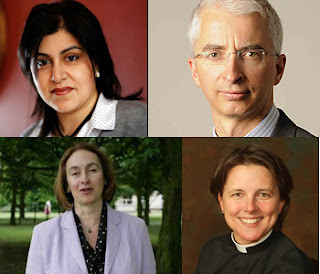
The judges include Baroness Warsi, Benedict Brogan, Dr. Jane Williams and Canon Lucy Winkett.
They will be looking for a good grasp of the subject and engagement with the issues involved, creativity and communication skills and, especially in the older categories, signs of some orignal thinking. Wouldn't it be great if someone from North Yorkshire could take on this challenge and win? Or what about readers from abroad? A good way to launch a career in writing, journalism or theology, to improve your confidence with words and to make your mark!
I would also like to offer anyone between 16 and 18 who would like the opportunity to write a post for this blog as a guest writer to do so.....why not have a go! If you enjoy writing it's a great way to get your writing read! For older writers we can help you think about your own blog!
The judges include Baroness Warsi, Benedict Brogan, Dr. Jane Williams and Canon Lucy Winkett.

They will be looking for a good grasp of the subject and engagement with the issues involved, creativity and communication skills and, especially in the older categories, signs of some orignal thinking. Wouldn't it be great if someone from North Yorkshire could take on this challenge and win? Or what about readers from abroad? A good way to launch a career in writing, journalism or theology, to improve your confidence with words and to make your mark!
I would also like to offer anyone between 16 and 18 who would like the opportunity to write a post for this blog as a guest writer to do so.....why not have a go! If you enjoy writing it's a great way to get your writing read! For older writers we can help you think about your own blog!
Subscribe to:
Posts (Atom)