 |
| God bless Roger the Rabbit from the FunKey website |
Thursday, 9 August 2012
FunKey Newsflash
The FunKey Service at St Mary's Richmond has three bits of exciting news! After less than six months they will soon have their first baptisms AND on September 21st the Archbishop of York will be visiting them to join in with a service AND they have just launched a splendid new blog with absolutely up to the minute info and great pics! Well worth a visit.


Foetal Alcohol Syndrome Disorder
Sarah Airey of the Foetal Alcohol Syndrome Disorders Trust has sent in some information asking churches to consider getting involved in FADS Day in some way. There are plenty of suggestions here for things you might do. There is a variety of medical opinion about the effect of a very small amount of alcohol in and just before pregnancy, but the tragedy, today, is that many women drink quite a bit even just socially without even realising this can affect their unborn child. We have friends who have adopted a child with the Disorder and the effect on her life because of the difficulties caused is far reaching and will be with her for the whole of her life.
The FASD Trust (Foetal Alcohol Spectrum Disorders) is organising a BIG BREAKFASD on 9th September. The Trust is urging people to abstain from alcohol for 9 days and organise a BIG BREAKFASD to fundraise and heighten general awareness of the condition. FADS Day is on the ninth day of the ninth month every year. The date signifies the nine months of pregnancy.
2. Big BreakFASD
Menu Suggestions:
On 9th September at 9.09am (or even 9.09pm) invite all your friends round for a delicious Big BreakFASD for a donation.
3. Church Involvement
As 9th September falls on a Sunday, we are inviting churches to take 9 minutes of their service to stop and pray for all those affected by FASD and the work of The FASD Trust.
Register your interest in praying for us and more details of how your church can be involved in this project, including daily prayer points for the 9 days, Powerpoint slides for your church notices, and how to organise a church BreakFASD, please e-mail Julia at prayer@fasdtrust.co.uk.
FASD is a series of preventable birth defects caused entirely by a woman drinking alcohol at any time during her pregnancy, often even before she knows that she is pregnant.
These
defects of the brain and body exist
only because of prenatal exposure to alcohol. Often the condition goes undiagnosed,
or is partially diagnosed / “misdiagnosed”, for example as autism or ADHD, and
this can lead to secondary disabilities.
The challenges a person with FASD faces may
include
The Brain
HOST A BIG BREAKFASD
National FASD Day - 9th September 2012
 |
| Helpline 01608 811599 |
The FASD Trust (Foetal Alcohol Spectrum Disorders) is organising a BIG BREAKFASD on 9th September. The Trust is urging people to abstain from alcohol for 9 days and organise a BIG BREAKFASD to fundraise and heighten general awareness of the condition. FADS Day is on the ninth day of the ninth month every year. The date signifies the nine months of pregnancy.
The
purpose of FASD Day is to promote awareness of the risks of consuming alcohol
during pregnancy, and to provide support and encouragement both for women
during an alcohol-free pregnancy, and for the families and carers looking after
children and adults affected by FASD.
Julia Brown, from The FASD Trust says, “Mums to be get mixed messages in pregnancy and social changes have led to an increase in female drinking, especially binge drinking and for younger women.”
Julia Brown, from The FASD Trust says, “Mums to be get mixed messages in pregnancy and social changes have led to an increase in female drinking, especially binge drinking and for younger women.”
“People
are now well aware that smoking is bad for the unborn baby, but medically
alcohol is more dangerous than cigarettes.
The most dangerous time is the first and last three months of pregnancy.
The first three is when the foetus is forming physically; the last three is
when the brain can suffer significant damage.”
“The
message should be that there is No
Safe Time and no Safe Limit for Drinking if you get pregnant.”
“FASD
Day, our alcohol abstinence FASD and BreakFASD are aimed at drawing attention
to these facts, and fundraising so that we can raise awareness of the problem.”
FASD is
a series of wide ranging and preventable birth defects caused entirely by a woman
drinking alcohol at any time during her pregnancy, often even before she knows
that she is pregnant. Problems include both physical difficulties
and memory, learning and attention disorders (see below for more details.)
·
1% of the
general population suffer from Foetal Alcohol Spectrum Disorders (FASD)
·
A
significant percentage of children being released for adoption suffer from FASD
– with figures as high as 90% in some areas of the UK
·
Only an
estimated 18-25% of those with FAS are able to live independently as adults.
Suggestions for drawing people's attention to FASD
1. Abstain from
alcohol for a 9-day FASD
Abstain from alcohol for the first nine days of September and donate
the money that would normally be spent on alcohol to The FASD Trust.
Register
your interest in the 9-day FASD from alcohol by emailing info@fasdtrust.co.uk for
a joining pack. Each day during September, we will be e-mailing you a note of
encouragement.
We would
like your photos, tweets, Facebook comments, etc in return.
On 9th September at 9.09am (or even 9.09pm) invite all your friends round for a delicious Big BreakFASD for a donation.
·
Continental selection of croissants, Danish
pastries, toast and preserves, coffee/tea orange juice
·
Bagels, scrambled egg and smoked salmon
·
Eggs Benedict
·
Kippers or Haddock
·
A pile of pancakes with maple syrup
·
Traditional bacon, egg, sausage
To register
your interest in holding a BreakFASD, send an e-mail to Patrick at info@fasdtrust.co.uk for
a poster, invitations to send to your friends, suggestions on how to make your
event successful and a link to a video to show your friends explaining about
FASD and the work of The FASD Trust.
3. Church Involvement
As 9th September falls on a Sunday, we are inviting churches to take 9 minutes of their service to stop and pray for all those affected by FASD and the work of The FASD Trust.
Register your interest in praying for us and more details of how your church can be involved in this project, including daily prayer points for the 9 days, Powerpoint slides for your church notices, and how to organise a church BreakFASD, please e-mail Julia at prayer@fasdtrust.co.uk.
To find
out more about plans to mark FASD Day in 2012 and to see how you can take part
in the planned activities or to make a donation, please see www.fasdtrust.co.uk
Make a donation
Donations
can be made through the Charity Choice web site: http://www.charitychoice.co.uk/the-fasd-trust-15175
****************
More about FASD
Foetal Alcohol Spectrum Disorders (FASD) is an umbrella term for
several diagnoses that are all related to prenatal exposure to alcohol (i.e.
while a baby is still in the womb).
FASD is a series of preventable birth defects caused entirely by a woman drinking alcohol at any time during her pregnancy, often even before she knows that she is pregnant.
·
1% of the
general population suffer from Foetal Alcohol Spectrum Disorders (FASD)
·
A
significant percentage of children being released for adoption suffer from FASD
– with figures as high as 90% in some areas of the UK
·
Only an
estimated 18-25% of those with FAS are able to live independently as adults.
The Brain
Intellectual Disability; lowered IQ
Memory Disorders
Learning
Disorders
Attention
Disorders
Sensory
Disorders
Speech
and Language Disorders
Mood Disorders
Behavioural
Disorders
Autistic-like
Behaviours
Sleep
Disorders
The Body
Visual and Eye Defects
Hearing
and Ear Defects
Mouth,
Teeth and Facial Defects
Weak Immune
System
Epilepsy
Liver
Damage
Kidney
Defects
Heart
Defects
Cerebral
Palsy, Muscular Defects
Height
and Weight Deficiencies
Hormonal
Disorders
Skeletal
Defects
Genital
Defects
Secondary Disabilities
Loneliness
School
Expulsions
Addictions
Chronic
Unemployment
Promiscuity
Unplanned
Pregnancies
Poverty
Criminality
Prison
Homelessness
Depression
and Suicide
About the FASD Trust
The FASD
Trust provides support, training and information to those affected by FASD (Foetal
Alcohol Spectrum Disorders), their parents/carers and the professionals, such
as teachers, doctors, social workers and others seeking to assist them.
In addition,
The FASD Trust seeks to raise awareness of FASD, in order to improve the
understanding of those affected and the support offered to them by the wider community
and to seek to lower the incidence rate of FASD in the UK, as people begin to
understand the potential risks of drinking alcohol during pregnancy.
The FASD
Trust was set up in 2007 by Simon & Julia Brown who have an adopted daughter
affected by FASD. After their daughter was diagnosed, Simon & Julia were
surprised by the lack of support and information available and The FASD Trust
was set up in response to the "gap" they encountered in support
services and the lack of knowledge about this condition.
The FASD
Trust reaches out to all sectors of society, to ensure the vulnerable individuals
with FASD are supported and protected. They now run support groups for families
across the UK, have a Medical & Healthcare Professionals Forum, have guides
available for teachers, and are developing a number of other resources,
especially for social workers, foster carers and adopters, as many of the most
severely affected children are found in the care system.
The FASD
Trust also works with young teenage parents, grandparents, birth parents and
seeks to be compassionate in its response to anyone affected by this lifelong,
but not life-limiting condition.
To register
your interest in holding a BreakFASD, send an e-mail to Patrick at info@fasdtrust.co.uk and
we will send you a poster, invites to send to your friends, suggestions on how
to make your event successful and we will send you nearer the time a link to a
video to show your friends explaining about FASD and the work of The FASD Trust.
Ruth Etchells
I was deeply saddened today to hear of the death, yesterday, of Ruth Etchells, the former Principal of St John's College Durham. Ruth inspired a generation of young people, many of whom have given their lives to the service of Christ in different ways. She preached a wonderful sermon about Esther (the only book in the Bible not to actually mention God but full of characters behind whom there is a great sense of God's activity) at Holy Trinity Cambridge in the early 1980's which I can only describe as one of the reasons I am a priest in the church today. I have so much for which to be grateful to her - in my generation, she opened our eyes to what was possible and believed we could, by the grace of God, and only by the grace of God, achieve it.

The Revd Professor David Wilkinson, present Principal of St John's College writes
'Ruth was the first female Principal of an Anglican College and was the architect of seeing John's as a place of academic excellence coupled with an ethos of a gentle and confident Christian faith.
'She was a person who embodied such an ethos. Many of us were deeply influenced by her pastoral encouragement, wisdom, inspiration and life of prayer. A gifted preacher and teacher, we were privileged that her last sermon was given as part of College Communion last year.
'We give thanks for such a rich and fruitful life and that at death she looked forward to resurrection with her Lord.
'A few years ago, [Dr] Margaret Masson and I nominated Ruth for an award from the University. She was awarded the Chancellor's Medal for services to the University. In what we wrote on that occasion you will get a sense of Ruth's unique contribution to St John's:
''Without Ruth Etchells' vision and tireless work, St John's may not have survived as a recognized College in Durham University. In addition, she has been a gifted academic, a groundbreaking leader and a servant of the University beyond Durham.
''Ruth Etchells arrived in Durham in 1968 to be a lecturer in the English Department and also to be a resident tutor at Trevelyan College where she was later Vice Principal. Her first and continuing contribution to the University was as an outstanding and inspiring teacher of undergraduates.
''For many years, she taught a groundbreaking course on Modern Drama which allowed students at the time to study cutting edge, even shocking material - it was the era of Beckett, Osborne, the emerging Pinter - and all this was new and radical within the context of Durham English. Ruth's course gave students exciting new insights into what it meant to study English Literature and in particular, ways in which it might have something to say about issues of ultimate meaning in their own lives and culture. Derived from her teaching, Etchell's popular book, "Unafraid to Be" was influential on a whole generation of students across the land and was one of the early catalysts to the emerging discipline of Theology and Literature. She influenced countless students to continue this kind of cross disciplinary exploration and engagement with contemporary culture; some of them in turn went on to become influential figures in their own right.

''Influential, inspiring and groundbreaking though she was as a teacher, Ruth's key contribution to the University was in her ten year Principalship of St John's College between 1979 and 1989. When Ruth took up this appointment in January 1979, it seemed like a risky and courageous choice.
''It was unexpected in a number of ways: Ruth was a lay person taking on the leadership of a college which was responsible for training clergy. Her discipline was English Literature, not Theology. And she was a woman - the first female Principal of a Church of England Theological College and at a time when the Church did not ordain women to the priesthood. The college had only started admitting women as students five year previously.
''There is no doubting that Ruth's dynamic leadership established St John's as a flourishing modern college respected in both University and Church. But her most exceptional contribution has probably been the fruit of her remarkable personal and pastoral skills, her perceptive ability to read people as well as she read her beloved literature and her capacity to inspire others to see even the most mundane as ablaze with meaning. Her sometimes uncanny prescience about people was always accompanied by a kindness and humanity and a sureness of touch that helped to restore perspective and hope. Confidante of shy undergraduates and Prince Bishops of the church alike; wise, forgiving, humane, and utterly confidential - Ruth continues to be a much valued advisor long after she has retired.
''Ruth's was one of the leading lay members of her time of the Church of England. She served most significantly, on the Crown Appointments Committee, using all her political, personal and spiritual skills to help shape the Church of England through the eighties and nineties.
''In retirement, Ruth has served on a number of significant national and local committees, continuing to serve both Church and local community wherever she could. She has also continued to write, most notably publishing a number of volumes of prayers. She also took up a new craft: working in stained glass.
''She has excelled in this new medium and her works continue to be in demand around Durham and further afield.
''Uncompromising yet deeply human, utterly serious yet with wonderful taste for the absurd, Ruth Etchells is a remarkable woman whose leadership and life has made an indelible impression on countless individuals and as well as on one small but much loved college in Durham.''
Thank you to Dr Margaret Masson and Professor David Wilkinson for those words of tribute which bring Ruth so vividly to mind. Margaret's address at the time of the award of the Chancellor's Medal to Ruth in 2010 can be read at http://www.dur.ac.uk/resources/ceremonies/congregation/etchells_ruth.pdf
Ruth was a poet, so I will end with her own words which, like her, gently challenge us to think differently.
The Ballad of the Judas Tree
In Hell there grew a Judas Tree
Where Judas hanged and died
Because he could not bear to see
His master crucified
Our Lord descended into Hell
And found his Judas there
For ever haning on the tree
Grown from his own despair
So Jesus cut his Judas down
And took him in his arms
"It was for this I came" he said
"And not to do you harm
My Father gave me twelve good men
And all of them I kept
Though one betrayed and one denied
Some fled and others slept
In three days' time I must return
To make the others glad
But first I had to come to Hell
And share the death you had
My tree will grow in place of yours
Its roots lie here as well
There is no final victory
Without this soul from Hell"
So when we all condemned him
As of every traitor worst
Remember that of all his men
Our Lord forgave him first
© D. Ruth Etchells
The Revd Professor David Wilkinson, present Principal of St John's College writes
'Ruth was the first female Principal of an Anglican College and was the architect of seeing John's as a place of academic excellence coupled with an ethos of a gentle and confident Christian faith.
'She was a person who embodied such an ethos. Many of us were deeply influenced by her pastoral encouragement, wisdom, inspiration and life of prayer. A gifted preacher and teacher, we were privileged that her last sermon was given as part of College Communion last year.
'We give thanks for such a rich and fruitful life and that at death she looked forward to resurrection with her Lord.
'A few years ago, [Dr] Margaret Masson and I nominated Ruth for an award from the University. She was awarded the Chancellor's Medal for services to the University. In what we wrote on that occasion you will get a sense of Ruth's unique contribution to St John's:
''Without Ruth Etchells' vision and tireless work, St John's may not have survived as a recognized College in Durham University. In addition, she has been a gifted academic, a groundbreaking leader and a servant of the University beyond Durham.
''Ruth Etchells arrived in Durham in 1968 to be a lecturer in the English Department and also to be a resident tutor at Trevelyan College where she was later Vice Principal. Her first and continuing contribution to the University was as an outstanding and inspiring teacher of undergraduates.
''For many years, she taught a groundbreaking course on Modern Drama which allowed students at the time to study cutting edge, even shocking material - it was the era of Beckett, Osborne, the emerging Pinter - and all this was new and radical within the context of Durham English. Ruth's course gave students exciting new insights into what it meant to study English Literature and in particular, ways in which it might have something to say about issues of ultimate meaning in their own lives and culture. Derived from her teaching, Etchell's popular book, "Unafraid to Be" was influential on a whole generation of students across the land and was one of the early catalysts to the emerging discipline of Theology and Literature. She influenced countless students to continue this kind of cross disciplinary exploration and engagement with contemporary culture; some of them in turn went on to become influential figures in their own right.
''Influential, inspiring and groundbreaking though she was as a teacher, Ruth's key contribution to the University was in her ten year Principalship of St John's College between 1979 and 1989. When Ruth took up this appointment in January 1979, it seemed like a risky and courageous choice.
''It was unexpected in a number of ways: Ruth was a lay person taking on the leadership of a college which was responsible for training clergy. Her discipline was English Literature, not Theology. And she was a woman - the first female Principal of a Church of England Theological College and at a time when the Church did not ordain women to the priesthood. The college had only started admitting women as students five year previously.
''There is no doubting that Ruth's dynamic leadership established St John's as a flourishing modern college respected in both University and Church. But her most exceptional contribution has probably been the fruit of her remarkable personal and pastoral skills, her perceptive ability to read people as well as she read her beloved literature and her capacity to inspire others to see even the most mundane as ablaze with meaning. Her sometimes uncanny prescience about people was always accompanied by a kindness and humanity and a sureness of touch that helped to restore perspective and hope. Confidante of shy undergraduates and Prince Bishops of the church alike; wise, forgiving, humane, and utterly confidential - Ruth continues to be a much valued advisor long after she has retired.
''Ruth's was one of the leading lay members of her time of the Church of England. She served most significantly, on the Crown Appointments Committee, using all her political, personal and spiritual skills to help shape the Church of England through the eighties and nineties.
''In retirement, Ruth has served on a number of significant national and local committees, continuing to serve both Church and local community wherever she could. She has also continued to write, most notably publishing a number of volumes of prayers. She also took up a new craft: working in stained glass.
''She has excelled in this new medium and her works continue to be in demand around Durham and further afield.
''Uncompromising yet deeply human, utterly serious yet with wonderful taste for the absurd, Ruth Etchells is a remarkable woman whose leadership and life has made an indelible impression on countless individuals and as well as on one small but much loved college in Durham.''
Thank you to Dr Margaret Masson and Professor David Wilkinson for those words of tribute which bring Ruth so vividly to mind. Margaret's address at the time of the award of the Chancellor's Medal to Ruth in 2010 can be read at http://www.dur.ac.uk/resources/ceremonies/congregation/etchells_ruth.pdf
Ruth was a poet, so I will end with her own words which, like her, gently challenge us to think differently.
The Ballad of the Judas Tree
In Hell there grew a Judas Tree
Where Judas hanged and died
Because he could not bear to see
His master crucified
Our Lord descended into Hell
And found his Judas there
For ever haning on the tree
Grown from his own despair
So Jesus cut his Judas down
And took him in his arms
"It was for this I came" he said
"And not to do you harm
My Father gave me twelve good men
And all of them I kept
Though one betrayed and one denied
Some fled and others slept
In three days' time I must return
To make the others glad
But first I had to come to Hell
And share the death you had
My tree will grow in place of yours
Its roots lie here as well
There is no final victory
Without this soul from Hell"
So when we all condemned him
As of every traitor worst
Remember that of all his men
Our Lord forgave him first
© D. Ruth Etchells
Celebrating Mary Sumner
When I was in Wales, earlier this summer, I picked up a little book of short stories called All Shall Be Well. It's edited by Stephanie Tillotson and Penny Anne Thomas and published by a Welsh company - Honno, Dinas Powys - this year. To my surprise, the second story in the book was by Jan Fortune, one of the first women to be ordained priest in the Church of England in 1994. In fact the title of the compendium is taken from her story. A priest who had four children in the first 10 years of her training and ministry. Interesting, I thought.
The story which unfolded was one of sheer inability on the part of senior members of the church and PCCs to accommodate the fact that young women need arrangements that will allow them time to bear and care for their children as well as to work. On one occasion it was suggested that she return to ministry ten days after having a Ceasarian. Her husband and also the husband of another woman mentioned in the story gave up their jobs at one point to care for the children yet PCCs, archdeacons and bishops acted together to force one of these women into a situation where she was only allowed to work part time (40 hours!) and only paid £5,000 pa so that the family had very little income. The story gets you inside just how this feels when you are young parents trying to hold together your home and family and cope with pregnancy in a parsonage. Sadly, Jan concludes, in the story, that she can no longer go on bringing her children up in the midst of these pressures. 'I walked into my youngest child's room and held him tightly. I remembered the pristine promise of each baby, the immensity of love and hope that came with each birth. 'This is life in all its fulness,' I said aloud to the half-asleep child. 'You, not them.' She feels she can no longer go on 'chasing parishes that seemed only to be afraid of mothers and resentful of children' . She is forced to choose. 'And I knew that all would be well.' She has since returned to parish ministry for a time and is the author of novels, poetry and several books about education.
 All this happened a decade ago. Although the church does now have a maternity policy I still hear, on a regular basis, from women ordinands and priests who find the inability of the institution to see pregnancy as more than an inconvenience hard to square with the glorious rhetoric of support for family life and mothers that is heard on a regular basis in prayers and sermons, especially on Mothering Sunday and at festivals of Mary the Mother of Christ. I spoke to someone last year who was thrown out of a cathedral for breast feeding her baby near a statue of Mary holding the infant Jesus. I heard recently from a young parish priest whose child had accute appendicitis; she had a funeral to take that morning and it took many phone calls before she could find cover and get into the waiting ambulance to go to hospital with her child. Yet I'm constantly told that we either can't or don't need to arrange for someone in every diocese to carry a bleep and be on call for such emergencies. I've heard so many sermons about bringing up children and supporting parents being the responsibility of the whole church, yet when it comes down to it we have (probably today) women in vicarages who just can't get hold of the help they need when a family crisis coincides with a serious ministerial need.
I wish I had £5 for every bishop who has asked me 'why don't more young women come forward for ministry?' Well, I'm going to point them to Jan's hearbreaking story in future.
Today is the day the church remembers Mary Sumner, the founder of the Mothers' Union. It was complete chance that I stumbled across Jan's story last night, but it did give me pause for thought as I presided at the Eucharist in the cathedral this morning. 'O Lord, bless all families...' What are we doing to support the real, lived, messy lives of mothers who are actually bearing children at this moment in time? Will the Mothers' Union campaign for proper treatment of women employed by the church and women clergy who are pregnant? We can't influence or inspire wider society when our own house is in disarray. Wouldn't it be good if churches could be communities that offer all mothers and fathers the kind of support and understanding they need to cope with the uncertainties that are a normal part of parenthood, recognising that this is a phase of life which requires flexibility and creativity in shaping life's routines.
A little post script about Honno, the publishing company, too. It has quite an inspiring story itself.
''Twenty-five years ago Honno began a revelatory publishing history that has become an essential facet of the whole culture of Wales. From classics, forgotten or neglected, to contemporary work across the creative and critical divides, it is Honno which has placed writing by and about women where it should always have been, at the centre of our past understanding and our future sensibility.'' --Dai Smith, Chair of the Arts Council of Wales
''Honno's story is one of heroic and necessary endurance; for a quarter of a century its workers have committed themselves to discovering new and innovative voices and to resurrecting unjustly neglected ones. A wonderful and incredible achievement that proves the colossal value of the written word.'' --Niall Griffiths
The story which unfolded was one of sheer inability on the part of senior members of the church and PCCs to accommodate the fact that young women need arrangements that will allow them time to bear and care for their children as well as to work. On one occasion it was suggested that she return to ministry ten days after having a Ceasarian. Her husband and also the husband of another woman mentioned in the story gave up their jobs at one point to care for the children yet PCCs, archdeacons and bishops acted together to force one of these women into a situation where she was only allowed to work part time (40 hours!) and only paid £5,000 pa so that the family had very little income. The story gets you inside just how this feels when you are young parents trying to hold together your home and family and cope with pregnancy in a parsonage. Sadly, Jan concludes, in the story, that she can no longer go on bringing her children up in the midst of these pressures. 'I walked into my youngest child's room and held him tightly. I remembered the pristine promise of each baby, the immensity of love and hope that came with each birth. 'This is life in all its fulness,' I said aloud to the half-asleep child. 'You, not them.' She feels she can no longer go on 'chasing parishes that seemed only to be afraid of mothers and resentful of children' . She is forced to choose. 'And I knew that all would be well.' She has since returned to parish ministry for a time and is the author of novels, poetry and several books about education.
All this happened a decade ago. Although the church does now have a maternity policy I still hear, on a regular basis, from women ordinands and priests who find the inability of the institution to see pregnancy as more than an inconvenience hard to square with the glorious rhetoric of support for family life and mothers that is heard on a regular basis in prayers and sermons, especially on Mothering Sunday and at festivals of Mary the Mother of Christ. I spoke to someone last year who was thrown out of a cathedral for breast feeding her baby near a statue of Mary holding the infant Jesus. I heard recently from a young parish priest whose child had accute appendicitis; she had a funeral to take that morning and it took many phone calls before she could find cover and get into the waiting ambulance to go to hospital with her child. Yet I'm constantly told that we either can't or don't need to arrange for someone in every diocese to carry a bleep and be on call for such emergencies. I've heard so many sermons about bringing up children and supporting parents being the responsibility of the whole church, yet when it comes down to it we have (probably today) women in vicarages who just can't get hold of the help they need when a family crisis coincides with a serious ministerial need. I wish I had £5 for every bishop who has asked me 'why don't more young women come forward for ministry?' Well, I'm going to point them to Jan's hearbreaking story in future.
Today is the day the church remembers Mary Sumner, the founder of the Mothers' Union. It was complete chance that I stumbled across Jan's story last night, but it did give me pause for thought as I presided at the Eucharist in the cathedral this morning. 'O Lord, bless all families...' What are we doing to support the real, lived, messy lives of mothers who are actually bearing children at this moment in time? Will the Mothers' Union campaign for proper treatment of women employed by the church and women clergy who are pregnant? We can't influence or inspire wider society when our own house is in disarray. Wouldn't it be good if churches could be communities that offer all mothers and fathers the kind of support and understanding they need to cope with the uncertainties that are a normal part of parenthood, recognising that this is a phase of life which requires flexibility and creativity in shaping life's routines.
*****************************
The Revd Dr Jan Fortune-Wood has been a parish priest at various times. She and her husband home educated their children and she has written two books about non-coercive parenting and autonomous education, Doing it Their Way and Without Boundaries, published by Educational Heretics Press. You can find her educaton website at www.home-education.org.uk You can also read an interview with her about her current work as an author on AmeriCymru at http://americymru.blogspot.co.uk
A little post script about Honno, the publishing company, too. It has quite an inspiring story itself.
''Twenty-five years ago Honno began a revelatory publishing history that has become an essential facet of the whole culture of Wales. From classics, forgotten or neglected, to contemporary work across the creative and critical divides, it is Honno which has placed writing by and about women where it should always have been, at the centre of our past understanding and our future sensibility.'' --Dai Smith, Chair of the Arts Council of Wales
''Honno's story is one of heroic and necessary endurance; for a quarter of a century its workers have committed themselves to discovering new and innovative voices and to resurrecting unjustly neglected ones. A wonderful and incredible achievement that proves the colossal value of the written word.'' --Niall Griffiths
Monday, 30 July 2012
Lammastide
Yesterday (29th July) Farm Crisis Network called for a day of prayer for our farmers. Thank you to Andy Rylands, our rural officer, who has sent this informative article which will help us to pray and think realistically for farmers at this busy time of year.
At Lammas tide, which on
August 1st, it is traditional to take a loaf, made from the first grain
of the harvest season, to be blessed in church and to ask for God’s blessing on
the ensuing harvest. This loaf is then used to celebrate communion. Given the extremes
of weather experienced in the Spring and early Summer this year, it is unlikely
that many farmers will be in a position to harvest their crops by this date.
Early in the year while the
talk was of drought conditions and hosepipe bans, many crops started to suffer
from lack of moisture. Then we experienced unprecedented and near continuous
rainfall for several months. Week after week we have heard of new records for
high rainfall being established; for the majority of us this has simply been
inconvenient while others have suffered dreadfully through repeated flooding. For
our farmers, who toil all year long to provide us with the food we need, it can
mean disaster.
Mild and wet conditions are
ideal for the growth of fungi which attack crops and potentially devastate the
yield. This leads to a difficult and potentially poor harvest with grain prices
on the increase. Sadly good harvest weather is not in sight as yet, so this is
of little comfort.
In the meantime, high grain
prices are pushing up feed prices for livestock farmers, who are also suffering
at the hands of the weather. Thousands of stock-farmers had to bring their
animals back indoors to prevent them damaging valuable grazing land in the wet
conditions. Because of this, many are obliged to feed their animals with costly
winter forage or costly bought in feed – and with haymaking badly hampered
until the weather improves, there is little prospect of being able to replenish
those stocks before this coming winter. Without such reserves, many are very worried
about the welfare of their animals in the cold months to come.
On top of all this, we see
dairy farmers, many of whom are already trying to cope with the devastation of
bovine tuberculosis among their herds, having to contend with draconian price
cuts for their milk, bringing them to a level, which for many is totally unsustainable.
There is a very real likelihood of many dairy farmers simply going out of
business.
Farming has always been a
risky business and farmers are well used to managing those risks. This year,
however, is proving to be quite exceptional, bringing with it concerns of a
much greater magnitude than normal. When these worries are amplified by the
isolation of rural living and the sense of neglect felt by many farmers, increasing
pressures can prove too much, sometimes resulting in tragic and devastating
consequences.
So this Lammas tide, take a
moment to consider the plight of our farmers and their families. They have the
burden of helping to feed the nation while managing and caring for our countryside in
such difficult circumstances.
Farm Crisis Network is
calling for a day of prayer on Sunday, 29th July for our farming
community who everyday face the consequences of the uncertain weather and who
often pay a much higher price than the consumers of their production.
The Right Reverend Donald Allister,
Bishop of Peterborough, who is also an FCN Trustee, has composed the following
prayer for use on Sunday:
Heavenly
Father,
the earth
is yours and the harvests are your bounty.
We pray
for our arable farmers
in this
year of extreme weather.
We pray
for our dairy farmers
with
supermarkets forcing the price of milk down
and with
bovine TB in some parts of the country.
We ask
your blessing on the harvest
and on
all who work in farming.
We ask
that farmers facing difficult times
may know
your love
and our
support.
Through
Jesus Christ our Lord.
Amen
Oswald's Outlook on Askrigg Antics
For those interested in local Dales news, or anyone planning to holiday in Wensleydale, there is an excellent and informative little website called Oswald's Outlook
Very well worth a visit! And many thanks to Christine Hallas, church warden at Askrigg, for drawing my attention to it.
I have to admit that I discovered this as a result of a visit to St Oswald's church Askrigg where I was down to preach on 'Good Shepherd' Sunday. I was quaking in my boots at the thought of preaching to the good folk of Wensleydale about shepherds! What could I possibly tell them that they didn't already know? And would my 'facts' be found wanting? Well, I needn't have worried - I asked them to tell me what they knew about shepherds and we pieced together a picture of what Jesus meant when He called Himself the 'Good Shepherd'. I had no idea that real shepherds can be strict disciplinarians with their sheep, throwing stones to keep them from wandering off on the wrong path, for example. How much more fun and more memorable to preach the sermon to each other. (And it looks as though the Jubilee celebrations were good fun in Askrigg, too!)
Very well worth a visit! And many thanks to Christine Hallas, church warden at Askrigg, for drawing my attention to it.
 |
| Table Talk from the Oswaldsoutlook website |
Drama at Kirkby Overblow
For those who follow the fortunes of Kirkby Overblow's Dramatic Society, you will be pleased (but perhaps not surprised) to hear that, at the recent Wharfedale Festival of Theatre Drama
Awards Ceremony KODS once again came
away with a small stash of awards.
Best
Stage Presentation trophy
- awarded to Bruce Noble for his fabulous set
Best
Cameo performance -
was jointly awarded to Lindsay McKenzie and Simon Hawkesworth
Best
programme design -
awarded to KODS
Telegraph
& Argos Trophy
- awarded to Adam Mckenzie for "his excellent standard of directing and
playing in a leading role"
Well done
to everyone involved!! We look forward to your autumn production.
Wednesday, 25 July 2012
Holy Land Pilgrimage

Alison Askew and Michael Ganville-Smith are leading an 8 day pilgrimage to the Holy Land which promises to be the trip of a lifetime if you have never been, and a colourful opportunity to renew your acquaintance with this wonderful land if you have been before.
The pilgrimage will take in Jerusalem (including the Via Dolorosa), Bethlehem, Nazareth, Capernaum, Jericho and Caesarea. You will sail on the Sea of Galilee, ascend the Mount of Temptation by cable car and visit the site thought to be the place to be of Jesus' baptism in the River Jordan. There will also be a chance to meet some of the local Christian community in Bethlehem. The cost is around £1,455.
If you would interested in joining the group, and travelling in company with a group of Christians from North Yorkshire, please conact Alison or Michael.
alison.askew@btinternet.co
mglansmith@hotmail.com
Sunday, 22 July 2012
St Mary Mgdalen (Leper) Chapel, Ripon

An Address for the Patronal Festival Civic Service
with the Mayors of Ripon, Knaresborough, Pateley Bridge, Richmond
and representatives of North Yorkshire County Council and Ripon City Council
Luke 8.1-3
What a contrast between this peaceful, holy little chapel and our cathedral! Many of us are used to going to the cathedral for the big events - civic and military services, services which mark the great events of our life as a community and nation or the great feasts of the Christian calendar. It speaks to us of the majesty and authority of God. But this little chapel, founded almost 900 years ago by Archbishop Thurstan of York, speaks to us of God's love for the poor and the forgotten, for those on the margins of our society and for us when we are at those places of abandonment we all reach at some point in our lives.
Like this chapel, many parish churches have, somewhere near the altar, a peep hole. Through this, the priest could be observed at Mass by the many lepers who were, of course, banned from entering the churches for fear of their spreading infection. Even here, at this hospital, lepers could not be admitted to public worship in the chapel. They were absolute outcasts.
Victoria Hyslop wrote movingly about the pain of exclusion for those suffering from leprosy in twentieth century Greece in her novel, The Island. Once a person was known to be infected with leprosy, they were banished for life to Spina Longa, an island off the coast of Crete. Hyslop tells the story of the wife of the boatman who takes supplies to the island. This woman contacts leprosy herself. Knowing that she will be taken to Spina Longa and never allowed to return, she has to pack hastily. She can only take a very few belongings with her. She chooses to take her place setting from the family's dinner service. Though she will never share a meal with her family again, she hopes that, at meal times, they will in each other's thoughts.
Leprosy cruelly cut people off from their families and loved ones and made them outcasts, feared and shunned by everyone. In some societies, it still does so today. Imagine how much this little hospital must have meant to those lepers who came here on pilgrimage or who lived around the city's boundaries - a place of welcome and rest, of fellowship and hospitality in a very bleak world.
It's appropriate that St Mary Magdalen was chosen as patron saint for this place. St Luke tells us that Jesus healed Mary, casting out seven demons. With today's medical insight, we might say that she suffered from a severe mental illness. Even today, people with such illnesses speak of stigmatization and a sense that they are not accepted or understood. Mary would have known how the lepers who came to this place felt. She responded to Jesus' healing and love as many of the lepers coming to this place would have responded to the welcome they found here - this was a place where they could belong.
This little chapel, at the heart of a community of hospitality has spoken of the power of God's love for the outcast and forlorn for nearly 900 years. It has been a beacon of hospitality for people most of us forget or would like to forget as we go about our busy lives. At times, it has fallen into disrepair or disuse, even being used to house pigs at one point in its history, I believe. So it's very good to see that, today, there is again a committed, regular worshipping congregation and a strong group of Friends who are not only caring about the building, but developing it so that it can continue to be a place of hospitality as well as of worship and witness.
St Mary Magdalen's chapel reminds Ripon and the surrounding areas of the power of God's love for all people. Today, there are many people living in this area of Yorkshire who feel marginalized - not fully part of society's opportunities and successes. There are families and single people who are glad of foodbanks to put food on their tables; debt counselling projects that report that anxiety about debt and actual debilitating debt is a growing problem; older, housebound people who long for company and a chat and people caring for sick relatives who would love to get out and have a few hours recreation. There are families who struggle to allow their children the opportunities for education and travel that many enjoy. The organizations that support people with dementia and mental illness are becoming cinderella services with need outstripping provision.
Yes, today, there are some who feel and indeed are excluded from mainstream society. Jesus spent the lion's share of His time with people like this, people like Mary Magdalen and the lepers and blind Bartimaeus. He was to be found, with them, on the margins, in the forgotten places with the forgotten people, in the homes and streets where a little love, a little attention, a little practical help would go a long way.
This quiet, holy place is one we treasure, in Ripon. As we draw aside and enter its doors, we are reminded that God is a God who sees and knows and loves those who feel themselves abandoned and forgotten, who struggle each day for even their basic needs. Perhaps, this morning, we might like to dedicate ourselves afresh to Mary's way of responding to God's love. She was so grateful for what Jesus had done for her that she decided to get involved in His ministry herself. She and a small group of women travelled around with Jesus and His disciples 'providing for them out of their resources'. Perhaps some were wealthy and gave money, perhaps others were there to work and to supply the day to day needs of the whole group. Can you imagine how that felt for Mary? She whom everyone had feared and shunned was now at the centre of this little group. She had friends, she had people with whom to share and, more than that, she was using her resources to help other people to a better place. She was caught up in the healing ministry of Jesus.
However little, however much we have to offer God in response to His loving kindness to us, we too can be followers of Mary's example, disciples of Jesus, public servants whose way of living includes especially those who need just a little help or extra attention or love to live their lives more fully.
A prayer for all who come into this chapel:
Father, we pray Thee to fill this house with Thy Spirit. Here may the poor find succour and the friendless friendship. Here may the tempted find power, the sorrowing comfort and the bereaved the truth that death hath now dominion over their beloved. Here let the fearing find a new courage and the doubting have their faith and hope confirmed. Here may the careless be awakened and all that are oppressed be freed. Hither may many be drawn by Thy love and go hence, their doubts resolved and faith renewed, their sins forgiven and their hearts aflame with Thy love.
From the Chapel Porch, Pleshey Retreat Centre; Oxford Book of Prayer no.487
For information about the Leprosy Mission go to
For details of the whole weekend's activities at St Mary Mag's go to
Greetings to the Revds John Langdon and Jackie Fox and to all the members of the congregation and the Friends of St Mary Magdalen, Ripon. Our prayers for your fellowship and work and also for the dedicated work of all who serve in local government in this region.
Abiding in Hope
I've noticed a lot of articles (blogs and media) lately suggesting that the church is dying. The authors of these pieces are hand-wringing over the fact that there aren't enough resources to keep things going, bemoaning the fact that churches are getting caught up into 'management-speak' and chastising these churches for losing sight of gospel values. Yet death is perhaps the least surprising concept to apply to the church which, in theological terms, is the body of Christ - Christ who died and who rose again. It's certainly true that churches (individual congregations and whole denominations) do struggle and wither and die out or, more prosaically, get to the point of closure. But it's also true that, while some get weaker and die, others blossom and flourish for a season. It is also true that where a church loses its vibrant, lively faith in the gospel, it is indeed as though the body is dying and being buried, but often, from that body, there comes a new shoot bearing fruit in the shape of individual Christians who have 'caught' the faith in that original fellowship and gone on to live it out in other Christian communities.
When I look around me at the churches of this area and indeed in the city where I used to minister, I see two things. I see the 'death' of shrinking numbers and wearied congregations but I also see the renewal of fresh lives changed by meeting Christ and tired lives brought to a place of re-invigorated engagement through exploring with new communities of faith and fresh opportunities for worship. Christian communities are being re-shaped and transformed at the present moment. In the West, they are much smaller than they were but they are also much more open to exploring what discipleship is. Church-going is no longer synonymous with practice of the faith - there are many unconventional, non-denominational and experimental groups outside or on the fringes of the old established denominations that are returning to the roots of the faith. They meet quietly or noisily in public places or each others' homes, members are often few in number and they break up again to reform in new groups to accommodate new members. They often have questions about leadership and the place of the sacraments. Remind you of anything? This shape of church is surely much more like the shape of the churches we meet in the New Testament and for the first three centuries in the history of Christianity.
I'm not sure that 'Christian' and 'large', or 'Christ-shaped' and 'powerfully influential' are pairs of words that go together well. Resources have often been meagre - at the start of the church's history, at times of persecution and at times before major spiritual awakenings. Size and the sharing of clergy, money and buildings are very human preoccupations. We all worry about our responsibilities and none more so than an archdeacon, I suspect! A more theologically significant question to ask is 'where is
this apparent lack of resources pointing us?' When churches struggle and need pruning and show signs of dying, there is always, in my experience, new growth in the off-ing. It might be in the very community where there is death - people of faith begin to emerge in other ways in the life of the community. Small groups of believers are suddenly released to focus on what is important and to re-invest their energy. Or it may be that, where whole areas or denominations begin to struggle, new life is found in radically different communities of faith. I do know that where churches are growing, it is almost always true that discipleship is taken very seriously; this happens in all sorts of different ways in different contexts, but attention to the disciplines of faith and, above all, devotion to the person of Christ are essential, whether this is expressed through worship and prayer, teaching, service, fellowship, generosity or usually a combination.
So I don't share the despair of some. The Johannine sayings of Jesus about abiding in Him, Jesus' metaphors of pruning and the parables about death for the sake of new life give me hope that what we are seeing are the birth pangs (Romans 8) of a, yes maybe smaller, but more deeply rooted Christian community in Europe. Perhaps a more honest and humble community of faith full of people who are determined to worship and witness and serve without huge resources but in the power of God's Spirit. Scarey, yes, but certainly grounds for hope.
Saturday, 21 July 2012
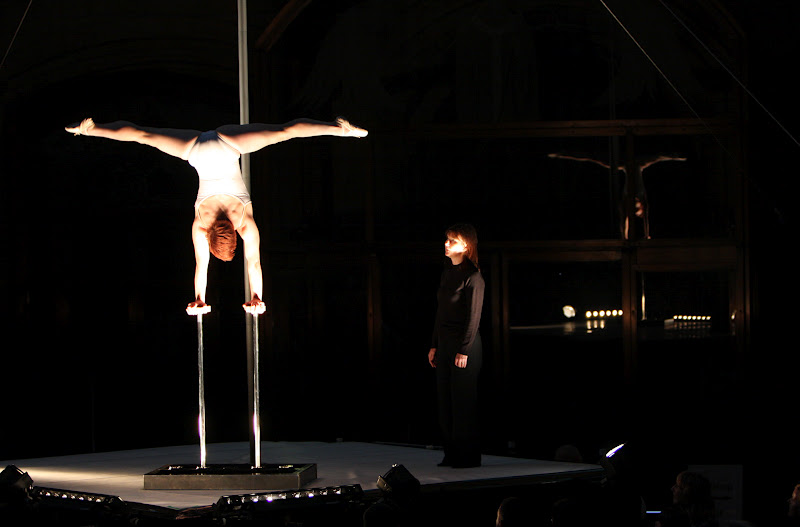
How Like An Angel at Ripon Cathedral
Bringing together Circa and I Fagiolini, two inspiring groups of artists in contemporary circus and vocal music. The third partner in the performance is the unique architecture and history of each cathedral where it is performed.
CIRCA originates in Brisbane, Australia, bringing us a daring new vision of circus, blending bodies, light, sound and artistry - this is the human body at its extremes of endurance, strength and versatility. 'Stunning., heart-stopping, unbearably beautiful.'
I FAGIOLINI is a group of vocal musicians rooted in the repertoire of the Renaissance and Baroque periods but also performing contemporary music. The sound moves around the building (as do the performers) and the quality of each individual voice and of the ensemble is arresting. Renaisssance polyphony at its stunning best in a building which lends itself to the form.
To hear a promotion for I Fagiolini's new show Tallis in Wonderland and to gain an insight into the aural quality of this performance go to
Circa Director Yaron Lifschitz
I Fagiolini Director Robert Hollingworth
Photos from Ripon Cathedral David M. Challoner




Subscribe to:
Posts (Atom)